Sorry this is running a bit late. Ending up lost in a great book earlier this week and put me behind on a lot of things.
Okay, I’ve said
a few times that I don’t want to use this blog to go over the basics. If you’ve found your way here, I’d like to pretend that you’ve got a loose grasp of your chosen writing format. But I’ve seen a few screenplays recently that… well, it’s apparent the basics of screenwriting aren’t as well-known or understood as they should be.
Now, to be clear, I’m talking about if I want to do this professionally. I want a studio to hire me and give me a pile of money so they can turn my script into… y’know, garbage. But, hey, they’re giving me a pile of money.
If I’m trying to do indie/YouTube things with my close circle of friends… format doesn’t really matter as much. No one else out of that circle’s going to see it, right? But if I’m thinking of Hollywood, of screenplay contests, of those big brass rings people have been thinking of for decades…
Well, I need to have some idea how a screenplay works.
So, here’s a dozen basic rules I should have down before I show my screenplay to someone.
And especially before I submit it to someone.
1) Basic Format—Scripts
are always in single space Courier 12. Always.
If you heard a story about a professional screenwriter who only works in Times Roman and turns in his or her work that way, I can tell you two things—that person’s already got the leeway you only get with a well-established career, and as soon as they handed the script in the whole thing was reformatted into Courier 12. It’s the industry standard for a number of reasons, including timing and scheduling. Every other department needs that script in Courier 12.
Ahhh, says clever wanna-be #8… if they can convert it anyway, then what difference does it make if I want to write in Times or Arial or Wingdings?
It doesn’t make any difference how I write it. But when I
submit it to a contest, an agent, or a production company, it has to be in Courier 12. Because scripts are always in Courier 12. Always. And I’m trying to convince people that I’m a professional.
One other thing—I don’t use scene numbers in a spec script. That’s something that comes up much later during the actual pre-production for a film. They’re a tool for the assistant directors and department heads, not the screenwriter. Putting them in now will just get me tagged as an amateur.
2) Basic Style—Always use third person, present tense. Always. The script is
what’s happening on screen right now. Characters can have dialogue where they talk about things in past tense, but all my action blocks and descriptions must be in third person, present tense.
A screenplay that switches person or dips back and forth between past and present tense is always a good tip-off for readers that this is someone’s short story or novel they sloppily adapted into screenplay format. There’s also usually a reason no one bought their short story or novel, and it’s related to the fact that they didn’t bother to learn how to format a screenplay…
3) Capitals— This isn’t that tough. I use capitals the first time we see a character so the reader knows this is someone new. I’ll go into this a bit more in a minute.
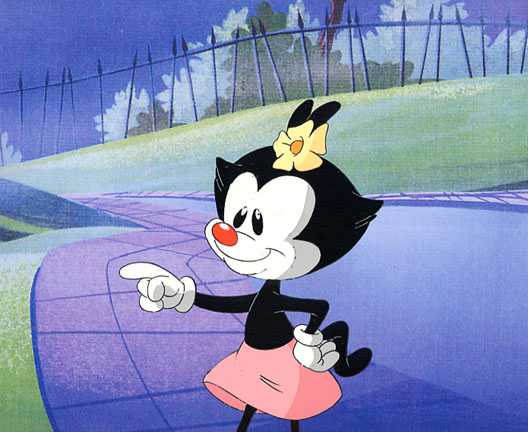
I also use capitals for emphasis when something important happens. When YAKKO IS SHOT or Dot’s exploring the graveyard and finds A SEVERED HAND ON THE GROUND. Keep in mind, though, that in this sense capitals are just like
exclamation points. The more often I use them, the less power they have, and eventually they’ll tip the scale and just start frustrating or annoying the reader.
Also, noneof this applies to dialogue. Again, for clarity, I should never apply the above rules to dialogue. If dialogue is in capitals it means someone is shouting–nothing else. To be clear, there is no other way to interpret capitals in dialogue. Capitals in dialogue=shouting. So even if my sister has never been mentioned in the script before, I don’t say “Have you met my sister CAROLYN?” I also don’t say “Hey, over there on the ground, is that A SEVERED HAND!?!!?”
Okay, I might shout if I see a severed hand. But am I supposed to shout?
4) Names– As I mentioned above, whenever I introduce a character, I put them in all caps in the action blocks. The very first time I see YAKKO WARNER I need to know he’s someone new. After that he’s just Yakko. For example…
Another man cut from the 50’s action cloth, ZACK “ZAP” MARSHALL is standing by another panel, a few feet down the wall from Lance’s. This one has three large buttons on it, marked “laser,” “missile,” and “x-ray”. Zap also wears a wide, high-tech belt buckle with a large button in the middle of it.
REX
Ready, Zap?
ZAP
Just give the command, Captain. I’m ready to blow it out of space.
Dialogue headers are
always all caps, using
the most common version of the character’s name, and I
never change dialogue headers for a character. Wakko’s dialogue is always headed with WAKKO, Dot’s is always headed with DOT. The only time they would change is if the character has completely changed identities on screen. For example, in
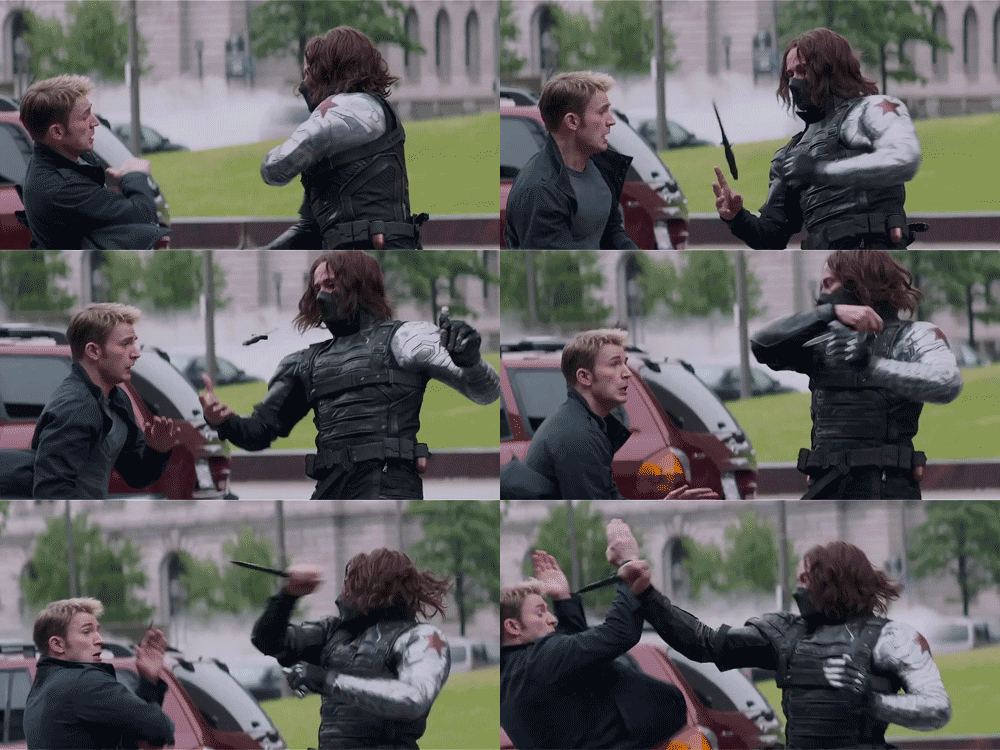
Captain America: The Winter Soldier we find out the title assassin is actually Cap’s supposedly-dead friend Bucky. He’s WINTER SOLDIER in headers until he’s revealed as BUCKY in either the action block (because you’re introducing a new character) or dialogue (where it still isn’t capitalized unless it’s shouted). Then his next dialogue header should be WINTER/BUCKY. Use that double-header once, and then he’s BUCKY from there on in.
5) Don’t Name every Character—In the abbreviated, concise format of a screenplay,
names are an important tool. They tell the reader that this character is someone we need to pay attention to. They’re important enough to the story that they rate a name and not just a title like MAN #2 or WAITRESS or OFFICER.
Alas, some idiot somewhere started pushing the idea of naming
everyone in a screenplay. The logic is that this gives more detail, nuance, or some such nonsense.
Do not do this. If my screenplay is
littered with extra names, the reader’s going to be tripping over themselves trying to keep all those names straight because the logical assumption is that they
need to be kept straight. I made the effort to name them, after all. So rather than focusing on the story, the reader’s trying to figure out how the woman in the mall and the taxi driver figure into the story. That’s breaking the flow and it’s going to piss them off when they realize they wasted time and effort juggling twenty-seven names for no reason.
Never name someone just to give them a name. No one—not even the actor—is going to be upset with just MAN #2. A friend of mine has made a good career out of being MAN #2. Trust me, MAN #2 is going to make a nice chunk of money, even for just one day on set.
6) Actually Describe Things—A few years back I got to interview screenwriter-director David Goyer (
The Dark Knight,
Man of Steel, the
Blade trilogy) and he told me a funny story about getting smacked down by Guillermo del Toro. It seems Goyer had described a character in a script as “a living nightmare.” del Toro looked at this and said “What does that even mean? That is
boolshit!”
There is a time and a place for pretty, evocative imagery and language. That time and place is not while writing a screenplay. As I mentioned above, the script is about what’s on screen right now, which means it has to be something we can actually see. A reader needs to be able to visualize what’s on the page, and it’s very important that multiple readers visualize the same thing. I can tell you Jack is a dead ringer for my old work friend Scott, but that doesn’t mean a damned thing if you don’t know what Scott looked like. “It’s a hundred times cooler than Armageddon” sounds really cool, but it’s really hard to do concept sketches and storyboards off that.
During our interview, Goyer actually admitted this issue bit him in the ass
when he directed one of his own scripts. He’d given a vague, roundabout description of a sequence, but once he was on set he actually had to figure out how to film it. Now he
needed a real description. So production came to a halt while Goyer and his assistant director tried to block out the mess that writer-Goyer had left them to deal with.
That leads nicely into…
7) Don’t write what we can’t see – A solid corollary to the last point. I’ve lost track of how many times I’ve seen stuff like this in amateur screenplays (and a few professional ones).
Tight on a man sitting in a restaurant, not eating. This is WAKKO, an advertising executive who just scored a multi-million dollar contract with Pepsi. He’s freaking out, though, because he also just found out his fiancé has been cheating on him with someone from her office. Another WOMAN! And now he’s questioning their whole relationship, himself, how did he miss this, how could he be so blind? And how is he going to explain this to his friends and family? No, Mom, Jane’s not coming to Thanksgiving–her bird’s getting stuffed by one of the girls from legal? Wakko keeps going back and forth between blaming her for cheating and blaming himself for not realizing why things felt strained between them.
What’s wrong with that paragraph? Well except for the first sentence… how is the audience expected to know any of this? All we’re going to see is a guy in a restaurant. Again, the script is what’s on screen
right now. Not what’s in someone’s head. That’s the stuff that
comes out through dialogue, action, and maybe some clever set dressing or wardrobe choices. But definitely not in a block of exposition in the action blocks.
8) Don’t Over-Describe Characters—This sounds a little contrary to some of the stuff I’ve just said, but trust me–it isn’t. A bad habit some writers develop—especially prose writers—is to go mad with character description. Hair color, eye color, ethnic background, education, music preferences, drink preferences, underwear preferences, etc… They take their entire
character sketch and drop it into the screenplay.
I don’t go nuts describing characters in scripts for a few reasons. One is that I always want to be tight and lean in a screenplay. Two is, as I just said above, I don’t want to describe anything the audience can’t see. Three is the one none of us like to think about—there’s a good chance this character will change. I can spend half a page describing Rosario Dawson and then they decide to cast Jennifer Lawrence. It happens.
Just give enough description so the character stands out from any other character. Really, if I’ve got more that two sentences of character description I’ve got too much. Yeah, I may have tons more, but remember—the script is about right now. Everything else about my character will come out in the course of the story through their dialogue and actions. If it doesn’t, my problem is not that I only got two sentences of character description.
9) Don’t act – Okay, you know those little descriptions under the dialogue header, usually in parentheses? These are called parentheticals. Sometimes, as a joke, they’re called wrylies. It’s a quick set of instructions to the actor about how the line’s supposed to be delivered.
Actors loatheparentheticals. Actors hate parentheticals the same way screenwriters hate producers who want us to change the ending so everyone was dead the whole time and to make Natalie Dormer’s part a lot bigger because she’s become kind of a hot item since we finished principal photography. It’s someone who has no idea how to do my job telling me how to do my job. Let’s look at a quick scene from one of my own scripts…
WENDY
(excited)
You did it!
TED
(proud)
Yeah, great shot, Zap!
LANCE
(relieved)
All clear again, Captain.
REX
(serious)
Yes. But for how long?
WENDY
(confused)
What do you mean, Rex?
REX
(thoughtful)
If it wasn’t for brave crewmen like Lance, Zap, Ted, and the rest of you, the galactispiders would make the starways far too dangerous.
Are those parentheticals really telling you anything useful? Most actors would be able to figure this stuff out just from context. So would any reader.

Which, for the record, is why none of these parentheticals are actually in my script—I just added them for this example.
Y’see, Timmy, there are only two times to use a parenthetical. One is if it’s life or death important to the story that this line is delivered a certain way. If the whole film is going to fall apart if Yakko doesn’t whisper in this scene, then add a (whispered) to that line of dialogue. Two is if I think there’s a very real chance this line could be misunderstood, even with all the context and lines before it, and the resulting misreading will destroy the entire film.
If I’ve got a parenthetical in my screenplay, I need to think long and hard about if it meets one of these two criteria. And then probably remove it anyway. They’re
the adverbs of screenwriting.
10) Don’t direct—Okay, what I just said about actors hating it when you tell them how to act? Directors loathewriters who fill up a script with directing notes. When I fill pages with stuff like “Pan over to reveal…” or “rack to see Yakko’s expression,” directors shake their heads, cross that out, and plan how they’re going to shoot the scene.
Like the parenthetical above, only put in direction if it’s life or death important to the film. If the story hinges on this being a crane shot, then put in—if the story really hinges on it. Me thinking this scene would be really cool with a crane does not make it a pivotal shot.
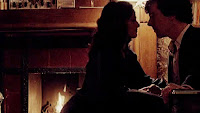
Plus, a lot of time adding direction honestly detracts from the story. Here’s a great example—how many of you have seen Sherlock? Remember the last moment he has alone with Irene Adler at 221B Baker Street, when they’re sitting at the fireplace and she’s trying to convince him to run away with her? It’s pretty important that we don’t focus on what Sherlock’s doing with his hands, right? Except if I point this out in my script, readers are going to spend the next ten pages trying to figure out what Sherlock’s doing with his hands, and that’s going to override a lot of what’s going on now. If I hadn’t mentioned it, they wouldn’t’ve thought about it, but now it’s essentially a low-level spoiler in my own script that his hands are doing something that will matter later. Don’t worry about that sort of thing. By the time the readers get to the flashback and figure it out, they’ll understand that when the movie is filmed we can’t focus on his hands at that point.
By the way, just to clarify—it doesn’t matter if
I plan on directing the script myself. The script I submit to a contest, an agent, or a producer, has to be a script for
anyone. If I’m actually going to be the director, I’ll have plenty of time later to add that stuff. Plus I’ll have my own notebook and schedule. For now, all those things are just taking up space on the page.
11) VO vs. OC—Okay there’s a huge difference between voice-over and off-camera. This is one of those little things that can get me tagged instantly as an amateur if I get them wrong.
Voice-over(V.O.) is when someone’s talking that no one else can hear. Announcers and narrators are usually voice-over. Train of thought is voice-over. “Little did he know…” tends to be voice-over. Another good tip—I will never, ever see lips moving for a voice-over.
Now off-camera(OC) is when someone’s talking that other characters can hear but the audience can’t see. For example, if Phoebe’s on her phone talking to Wakko, and we hear his voice, he’s off-camera, notvoice over. That old bit when everyone hears a voice, turns, and sees that Dot has come into the room—that’s off-camera.
I want to use OC carefully, because too much makes it look like I’m trying to direct again (see above). I’m not going to put it during an intercut phone call. I don’t use it when we know Dot’s on the other side of the room but we’re not seeing her at this moment.
12) Don’t use archaic terminology – Forsooth, whenst thou uses scrivening of yesteryore, thy words appearst equally of yesteryore. And few and far between liest those who show interest in the dry, dusty bones of a mouldering anecdote.
Or, as we say today, no one’s interested in an old script.
It used to be common to end every scene with CUT TO or FADE, or to end every page with (CONTINUED). It also used to be common for the US military to have a lot of horses and bayonets. In both instances, that hasn’t been the way it works for years. When I started working in the film industry back in 1993, CUT TO was already dead. (CONTINUED) was on life support, and only cropped up in very limited use. Usually for ongoing dialogue.
If I’ve been using an old script from
The Maltese Falcon,
The Godfatheror
Rocky to learn this terminology and formatting—I need to toss it. The film industry grows and changes like any other industry. If my reference script wasn’t written in the past ten years, it’s probably going to give me more bad habits than good ones.
This is also one of the big reasons I wanted to go over all of this again. At this point, it’s been about nine and a half years since I worked in the film industry full-time. My experience is getting old, and I’m smart enough to admit that.
Some people are not.
Or just don’t care as long as you’re going to pay them…
13) Don’t use real celebrities as characters—A bonus point I’ve mentioned before. I’ve read screenplays where one character ended up at a resort with Johnny Depp, another one where someone dated Carmen Electra, and a really, really creepy one about George Clooney getting involved with a producer… who happened to have
the same name as the screenwriter. Unless your movie is already in production and Helen Mirren happens to be your best friend in the world who would do anything for you, do not use her as a character in your screenplay.
Yeah, I’m sure some of you are already calling foul. After all, haven’t I littered the
Ex-Heroes series with mentions of celebrity zombies? Well, yes I did. But that’s the difference between a book and a screenplay—you can still read the book if Nathan Fillion, Jessica Alba, or Alex Trebek don’t show up. Now if someone ever decides to make a movie out of the book… well, then there’ll probably be issues.
Although I feel relatively safe saying Fillion would show up.
So, thirteen tips to a more coherent, professional-looking screenplay. I’m betting the majority of you knew most of them. But a few of you… well, now you know.
And knowing is half the battle.
Next week… I wanted to talk about some very bad people and how to make them good.
Until then, go write.



 It’s fine to tell myself that I’m waiting for the muse. Or that I’m reading a how-to book about crafting the perfect first sentence. Or that playing Dawn of War III is going to be a vital part of my creative process. We all have our own methods when it comes to writing. Like that corset.