
December 3, 2015

Over-Elaborate Paint Schemes

Hope you all had a nice week off and got a lot of writing done. Or at least a lot of relaxing so you’re fresh and ready to write again.

As it turns out, this little rant has turned out to be well-timed… but we’ll get to that in a bit.

For now, I wanted to talk about paint and simplicity.

As one or two of you might know, I am a bit of a miniature wargamer, or, as they’re known to the greater world at large, a geek. Yep, I build little toy soldiers and beasties, scale scenery, vehicles, the whole deal. I used to be much more into it than I am today, but I still enjoy building the models and playing with my group now and then.

Recently I was painting some models and remembered an old article I’d read ages back in one of the hobby magazines I subscribed to (again, used to be much more into it). They had a regular column on painting techniques for little toy soldiers, and one month a guest columnist wrote about what he called “non-metallic metallics.” It was a style of painting where you made swords, guns, armor, and so on look like steel and gold without actually using steel or gold paint. Instead you’d use lots of whites, blues, grays, oranges, and yellows—all different shades—to create highlights and reflections and the appearance of shiny metal. Make sense?  So much better, he said. So much more realistic.  It really brought the miniatures to life.

Now, the very next month they ran an article from another painter—their regular guy, in fact—and his article amounted to “no, no, NO!” He was very much against the whole non-metallic metallics thing. As he explained, it was using a lot of time and extra paint to create the same effect you’d get naturally by just using the metallic paints. Plus, the non-metallic style was completely angle-dependent. It worked well for displays and dioramas, but wasn’t appropriate for models that would be out on a tabletop battlefield and viewed from many different directions. That’s when the non-metallic illusion would break down. As he explained, why buy seven or eight pots of paint to achieve what—for these purposes—you could do much better with one?

That was the last painting column, if memory serves, and the regular guy was never mentioned again. The company that published the magazine also sold the paint. Draw your own conclusions about what happened there.

Now, aside from the capitalist warning, what’s the message here?

There’s a subset of folks who insist things can’t be simple. Simple is stupid. Simple is for amateurs, they’ll tell you, not professionals. You’re not going to use that common, easy paint scheme, are you? Because you’ll never be considered an expert that way

Unfortunately, too many of these people consider themselves gurus of some kind or another. They’ll charge you good money for bad advice. Advice they’ll usually try to pitch as rules.
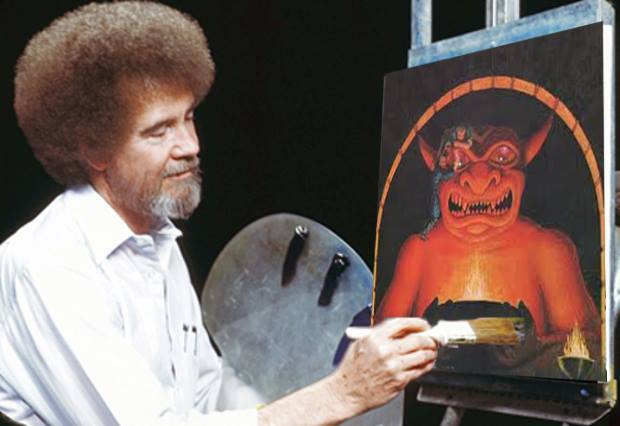
There’s nothing wrong with simple. Having a simple paint scheme let me paint the bulk of my Space Marine army in a few weekends rather than a few months. I had close to a hundred little soldiers the size of my thumb—I wasn’t going to spend hours and hours on each one.

But…

There were a couple models I did lavish with some extra time. Captain Machiavel got a lot of fine detail picked out on his armor. I put highlights on Veteran Sergeant Constantine’s sword. Veteran Dreadnaught Faustus has a ton of scrollwork on his weapons and purity seals.

(Yes, I named some of my little toy soldiers—stay on topic, okay?)

Just like there’s nothing wrong with simplicity, there’s nothing inherently wrong with complexity, either. It’s all about having the experience to know when each is appropriate. I wasn’t going to spend hours and hours painting each of the rank-and-file soldiers, because I didn’t want a hundred individual paint jobs distracting from the look of the army as a whole. That said, I’m still going to make the army commander, squad leaders, and big models look good because… well, they’re the ones people are going to focus on.

See where I’m going with this?

As an aspiring writer, I encountered lots of folks trying to tell me my writing wasn’t sophisticated enough. That my vocabulary was too simplistic. And I listened to them. I started using a lot more adverbs. I tried to use metaphors and similes in the description of every person, place, and thing that appeared in my stories. Hell, for a while I made a point of  never using the same dialogue descriptor twice on a page. And I never, ever used said. Said was stupid. It for amateurs, and I was a professional

Thing is, none of this made my writing any better.  Oh, sure, it was boosting my word count a lot, but it wasn’t really improving my ability. In fact, one of the first times I ever got to sit down with an actual professional editor—someone who could pay me money for my work—his two big pieces of advice for me were to cut all my adverbs and go back to using said.

Let’s do a quick test. Grab a novel or anthology that’s near you. Not a Kindle, if that’s possible—a real book will work better for this. Preferably something you’re familiar with.

Got one?  Flip through it, or just open at random once or thrice.  You’re looking for a page with dialogue, not exposition.  Found it?  Count up how many times said appears on that page.

I’m willing to bet it’s there a decent number of times. And I bet you never noticed until I just asked you to count them up. Said is invisible. When I use said, readers can enjoy my overall story rather than getting caught up in individual sentences that break the flow.

Y’see, Timmy, using complex phrasing and obscure words doesn’t automatically make me a good writer. Especially if there’s no point to my complexity and I don’t understand the words I’m using. If that’s the case, trying to do this can actually make me a worse writer. I’m suddenly the guy trying to do fine detail work with a paint roller, or trying to cook a five course meal when I haven’t quite figured out the toaster yet.

Again, there’s nothing wrong with being more sophisticated, or to using ten-syllable words over two-syllable ones. There just needs to be a point to it. It needs to serve a purpose in my telling of this story. If it’s just me, the author, trying to show off how impressive I am and how extensive my vocabulary is… well, that’s not really helping the story. It’s just the literary equivalent of hanging rubber testicles on the back of my truck.

I mostly use said in my writing. Mostly.  I’m not against having my characters shoutor mutter or snap or whisper or shriek or hissor call out. When they do, though, I have a solid reason for making that bit of dialogue stand out on the page.

So ignore those folks saying you must be more complex with a wider vocabulary. And the ones telling you to always keep it simple. Just focus on telling your story the best way you can.

And that’s that.

In other news… It is, alas, that time of year. So, if I may, I’d like to direct your attention to my usual Black Friday offer for those who need it, the standard Cyber Monday appeal to consumer capitalism, and the suggestions of much better stuff to give the readers in your life.

I’d also like to point out that my publisher, Penguin Random House, is doing a fantastic online campaign this season called Give a Book. If you’re on Facebook or Twitter, just use the hashtag #giveabook when you talk about buying books for friends, family, loved ones, and so on. Every time someone uses the hashtag, from now until December 24th, PRH is going to donate a book to the First Book literary charity. The goal this year is to hit 35,000 books (last year they aimed for 25,000 and hit 37,000). So take a minute out of your holiday frenzy and do something for a good cause.

Next time, I’d like to talk about the people we enjoy reading about.

Until then… go write.
December 20, 2013

Black Christmas

If you’ve been following this ranty blog for any amount of time, you’ve probably heard me mention Shane Black once or thrice. For those who came in late, he’s one of the men behind the million-dollar spec-script boom 20 years ago. You might know him as the writer of films like The Monster SquadLethal Weapon, The Last Boy Scout, and The Long Kiss Goodnight.

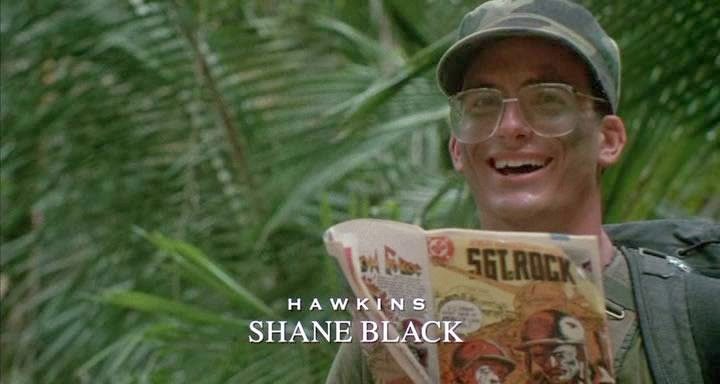
(Supposedly, an unwritten part of his deal for Lethal Weapon was getting to be in an action film, so the studio stuck him in some stupid alien-fighting-bodybuilders-in-the-jungle movie that no one was going to see–never expecting Black would rewrite all his dialogue to become one of the most memorable characters in the film…)

He took some time off from Hollywood and then returned a few years back as the writer-director of the award-winning Kiss Kiss, Bang Bang, which propelled Robert Downey Jr. back into the public eye. Then the two of them got together again for this summer’s Iron Man 3, which Black directed and co-wrote.

Anyway, back when I used to write for Creative Screenwriting, Black was kind of a Hollywood legend as a person and as a writer. So when the editor of CS Weekly asked us for December article ideas, I tossed out doing a general interview with Black. After all, the man’s set almost every movie he’s written at Christmastime—he had to have something to say about it. My editor agreed it would be a neat thing and put out some feelers, and we both kind of forgot about it. We were a very small, niche film magazine, and he was… well, he was Shane Black.

So when Black wrote back in less than a week and said “Sure, let’s grab a coffee or something,” you can imagine the squeals of glee.

Alas, reality hit just as quick. At this point the magazine was starting to struggle financially and my first novel, Ex-Heroes, wasn’t going to see print for another three months. The squeals of glee faded and I suddenly realized I couldn’t afford to grab a coffee. Hell, I wasn’t sure I could afford gas to drive to a Starbucks to meet him. After the shame faded, I wrote back with some lame excuses about sound quality and not wanting to waste his time. We set up a phone interview and I missed my big chance to hang out with Shane Black for an hour.

Fortunately, he was very pleasant and gracious on the phone, and it was one of those conversations where I felt like I learned more about storytelling in forty-odd minutes than I had in some college classes.

A few of the usual points… I’m in bold, asking the questions.  Keep in mind a lot of these aren’t the exact, word-for-word questions I asked (which tended to be a bit more organic and conversational), so if the answer seems a bit off, don’t stress out over it. Any links are entirely mine and aren’t meant to imply Mr. Black was specifically endorsing any of the ideas I’ve brought up here on the ranty blog—it’s just me linking from something he’s said to something similar that I’ve said (some of it inspired by this conversation).

By the very nature of this discussion, there will probably be a few small spoilers in here, though not many. Check out some of his movies if you haven’t already seen them. They’re clever, damned fun, and filled with fantastic characters.

Material from this interview was originally used for a “From The Trenches” article that appeared in the December 18th, 2009 issue of CS Weekly.

So, anyway, here’s me talking with Shane Black  about Santa, Christmas, storytelling, and Frankenstein in the Wild West.

Happy Holidays.

Were you a big fan of Christmas specials and movies growing up? What are some of your favorites?
Well, it’s interesting. I watch all the old Christmas movies and I like them for odd reasons. Like It’s A Wonderful Life.  It’s a Christmas movie, but within it they have a lot of bizarre, Capra-esque touches that are more indicative of just life. The scene where the gym starts to open–the floor starts to pull back and there’s a swimming pool underneath. Someone falls in and then everyone just jumps in the pool. That moment is as fresh today as it was back then. That kind of crazy improv moment where everyone starts laughing and jumping in. Even as a kid I was struck by that. “Wow, that’s a different kind of moment than most movies. That feels like it just happened almost by accident.”

My favorite Christmas film is probably this Spanish Santa Claus movie. It’s called Santa Claus and I even used a bit of it in Kiss Kiss, Bang Bang. Basically, Santa Claus fights the Devil. The Devil tries to stop Christmas. There’s this one scene where he just runs around the room doing gymnastics. You’ve got to see it. You’ve got to pick it up and look at it— The Devil’s this really athletic, slightly gay-looking guy who can blow flames through a phone line. If he calls you on the phone, flames come out the receiver and they singe your ear. That’s probably my favorite. Santa’s really lame and the effects are terrible.

My other favorite was called Santa Claus and the Ice Cream Bunny. There’s no snow. It was filmed in Florida in broad daylight. Santa’s sled is stuck because there’s no snow, and they’re all waiting for the Ice Cream Bunny. While they’re waiting Santa tells all the kids the story of Jack and the Beanstalk, which takes roughly 50 -75 minutes. At the end of which the Ice Cream Bunny shows up and everyone says “now we’re safe.” I can’t believe some of the frauds–even as a child–that were perpetrated on me (chuckles). It’s pretty amazing.

About half your films have been set at Christmas. I know your first script, Shadow Company, was originally set at Halloween, and then you rewrote it as Christmas in a later draft.  Why?
Yeah.  Christmas for some reason… Even though it’s a worldwide phenomenon I always associate it with a certain kind of American way of life. It’s also sort of a hushed period, during which, for a period of time, we agree to suspend hostility. I’m always fascinated by the almost palpable sense in the air that something’s different at Christmas.

If you look at a tipping point scenario– how many people does it take to start a standing ovation? Just one. And then in five seconds two other people, then three, then four, then 75,000 are clapping. Because the tipping point is as simple as one person pushing in that direction. And it can go ugly just as easily. It can go the other direction. One person starts to get out of hand and then everyone’s out of hand.

So Christmas to me represented the best we have in terms of keeping things on that side of the dial. A period in which, for whatever reason, the tipping point was more likely to bump into someone on the street and have them say “Oh, hey man, my bad,” then to have him say “Fuck you, buddy! Watch where you’re going!” That was remarkable to me.

Also in California, Christmas, if you look at it as a substance almost, as a thing more than an idea, Christmas exists out here in California but in these indescribably beautiful ways to me. You have to dig for it. It’s not a 40 foot Christmas tree on the White House lawn, it’s a little broken, plastic Madonna with a flash bulb inside hanging off a Mexican lunch wagon. It’s a little strand of colored light in some cheap trailer in the blinding sunlight, but it’s still protesting its Christmas-ness. I adore little touches of Christmas that indicate subtly… It’s like talismans. You walk around and these are the magic. These are your touchstones. Little bits of Christmas that remind us that this doesn’t have to be a blinded, blighted, sun-washed, hostile place to live. Christmas has always had that magic ability to me, to exist almost like a magic substance that you find little bit of if you dig carefully enough for it. I know that sounds kind of crazy.

No, I’m intrigued. When did you develop this view? Was Lethal Weapon set at Christmas because of this or did the… the philosophy of Christmas develop along the way?

Along the way. Well, Lethal Weapon is a Frankenstein story to me. It’s a guy who’s a monster of sorts, who sits in his trailer and watches TV.  People despise him, they revile him, because… it’s like a western. They think the west is tame. They think they’re safe and secure in this sedentary little suburbia. This sort of lulling effect that whatever violence and terror are in the world, we’ve managed to secure ourselves from it. But he knows different. Frankenstein in his trailer, he’s been with violence, he’s lived violence. He knows that its still there. The west is not tame, it is not gentrified. When violence, in Lethal Weapon, comes to the suburbs and takes this guy’s daughter and kills cops, they go to Frankenstein and say “Look, we hate you for what we do. We think you’re an anomaly at best and a monster at worst, but now we need you because you’re the only one who understands this. We’ve gotten hypnotized by tranquility. We forgot that violence is still there, and you’re the one who can deal with that, so now we need to let you out of your cage.” That was the idea. Christmas, it seemed to me, was the most pleasant, lulling, hypnotizing atmosphere in which to forget that violence can be so sudden and swift and just invade our private lives.

Did you actually study screenwriting?
Nah.  I took theater classes at UCLA. I was studying stagecraft and acting. It was a Mickey Mouse major.  y finals often were painting sets, y’know? It was kind of a cakewalk though college. I took all the requirements– I liked theater, I liked movies, but I’d never seen a screenplay and I thought they were impossibly difficult. Coming from back east I just assumed  movies were something that floated through the ether and appeared on your TV screen and some magician wrote them, but there was certainly no way I could. Then I read a script and it was so easy. I read another one and said “I can do this. This is really rather simple.” So I never took classes, I just read scriptsI loved.

My style, such as it is, that sometime people comment on, is really cribbed from two sources. One is William Goldman, who has a kind of chummy, folksy, storytelling style. It’s almost as though a guy in a bar is talking to you from his bar stool. And then Walter Hill, who is just completely terse and sparing and has this real spartan prose that’s just punchy and has this wonderful effect of just gut-punching you. I took those two and I slammed them together, and that’s what I use. People say it’s interesting. Mostly it’s a rip-off. It’s Goldman meets Walter Hill.

Did you always write like this or are there some older Shane Black scripts that will never see the light of day?
No, the first scripts I wrote were scripts I wrote after I decided to go out and see what they look like. So I picked up William Goldman,  I picked up Walter Hill, and then I wrote Shadow Company, which even on the page, the ’84 version, looks exactly like a Goldman script. Lethal Weapon, it’s pretty much in the style of those two writers. Material aside. Material is different, I’m talking solely about the style on the page and learning the logistics of how to do it. Those two were my mentors.  ater mentors were people like James L. Brooks, who taught me an amazing amount, and Joel Silver, of all people, qualifies as a mentor.

How do you generally write? Do you use outlines or notecards or just start cranking it out from page one?
I don’t really use notecards. What I do is I try to figure out what the piece is about and link that to the story arc or the character arc. I always think there’s two things going on in any script–there’s the story and then there’s the plot. The plot is the events. If it’s a heist film, it’s how they get in and out. But the story is why we’re there, why we’re watching the events. It’s what’s going on with the characters.  And theme above that. Once I get those things, once I know what the theme is and what it’s about, I can start trying on story beats and plot beats to see if they feel like they’re moving, but they have to relate to the overall theme. If you look at The Dark Knight, you’ll find before those guys wrote a word of script, they knew exactly what their movie was about. All the themes were in place. Sometimes they has to bend the scenes in The Dark Knight to fit the theme they were trying to get across. It’s clear they didn’t write the scenes and then look for what they were about, they clearly knew where they were headed. So thematically I get a sense of what the movie’s gotta be, but I don’t use notecards.

I can juggle a lot in my head. I can’t get more than say, twenty pages, without planning ahead.

How long does it normally take you to get a first draft of something?
I try to keep by studio standards, which is three months. They give you three months from commencement pay to final payment, and I think that’s enough time if you really work at it. We did a draft that I really loved, and it did not make the screen, of Last Action Hero, my partner and I. We did that in six weeks and I was very proud of that. From sitting down with this original screenplay and completely rewriting and retooling it. We were good, we were fast.

You mentioned your partner. I know you worked with Fred Dekker for a while–have you gone back to writing with a partner?
Lately just to facilitate things. It takes me so long to think of ideas and so long to convince myself to get to work, and there’s so much fear involved. Writing to me is a process of just desperately trying, on a daily basis, to concentrate until something becomes more interesting than my fear. Then you’re sucked in and you start doing the work, but up ’till then it’s just horrifying to me. So if I can have help, if someone’s in the sinking boat with me, even if we’re both going to drown, at least there’s a comfort to not being alone. I’ll write the next one solo.

Now, you took time off, came back with a new script you shopped around, and nobody knew who you were. That was Kiss Kiss, Bang Bang, right?
It was.  Most people would have nothing to do with it.

Did planning to direct it change how you wrote it?
No, I thought about that. That was when I was dealing with Jim Brooks. He basically said “You don’t need to worry because you direct on paper. You don’t call shots, but you call mood and you call progression and pace and emphasis and just about everything else.” So I may have even done a little more of that on Kiss Kiss, Bang Bang.

Now that you’ve sat in the director’s chair, has it changed how you approach a script?
No, except I’m even more conscious of what will later be shoe leather. The greatest shoemakers in the world supposedly can make a pair of shoes and leave no [extra] leather. They didn’t waste any. I’m very conscious now as a director. If you’ve got two scenes, like a newscaster and a scene before that of a conversation, can’t you have the conversation with the newscaster in the background and do it in one? It’s just shoe leather. No shoe leather.

It’s probably safe to say a lot of people have offbeat movies they watch this time of year, and a bunch of them are probably your movies. Is there anything unusual you like to watch at the holidays?
Oddly enough, every year about this time, for no reason I can fathom, I watch The Exorcist, my favorite movie [chuckles].  Every year I’m reminded of how it doesn’t age, not one single day. It’s as riveting as it ever has been.
December 24, 2010 / 3 Comments

The Most Wonderful Time of the Year

Ahhh, Christmas. Time for family and friends. Eggnog and presents. Gathering around the fireplace and maybe watching a few holiday classics on the tube.

Also a great time for psychopaths, invading aliens, and big explosions.

I should probably explain that last bit.

Are you sitting comfortably?

Then we’ll begin.

In a way, holidays make for great settings because they come pre-packaged for a writer. Much in the same way saying “Angelina” conjures the mental image of a certain actress, I can tell you “the neighborhood is decorated for Christmas,” and I’ve set the stage. Just like that.

Oh, sure, I can go into more detail if I really need to. It might be very important that the Hendersons decorated that small pine on their front lawn and the Applebaums have mistletoe over their front door. And maybe that old Mister King has nothing on his lawn. But I’ve set out all the broad strokes with just six words. Even if the description never went any further, you know what Sawmill Drive or Sunset Boulevard look like. How many pages of writing does that save me?

Major holidays are great shorthand for the time of year and tone of a story. This can help you make the ideas behind your story even more powerful. Is there anything more romantic than meeting your true love on Valentine’s Day? We almost expect serial killers on Halloween. The 4th of July is just brimming with patriotism here in the U.S.

Y’know, it just struck me while writing that… How many countries have “Independence from England” as a national holiday? Dozens, right? And what’s England got? Guy Fawkes Day. They celebrate the day they didn’t let religious extremists take over.

Anyway…

If your setting lines up with your story, you’ve almost got a theme going there. If your characters are discussing peace on earth while decorating a Christmas tree, good for you. Maybe they’re talking about forgotten promises at New Year’s or being grateful at Thanksgiving. So if you’ve got a story that follows some holiday-centric ideas, it might be worth setting it at said holiday.

That being said there’s also a Clarke’s Law-type issue to consider here. Sometimes the best story to set at a given holiday is, in fact, the worst story for that holiday. For example…

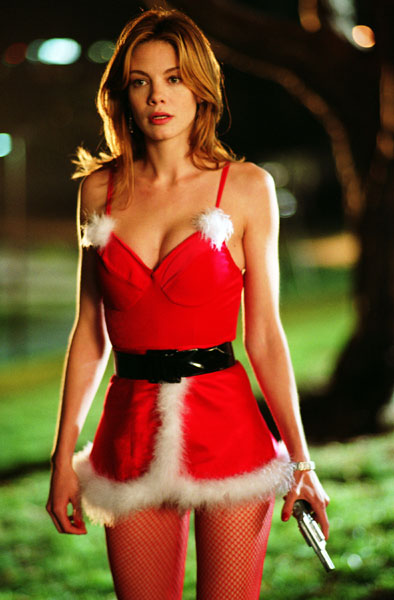
If you’ve been reading this blog for any amount of time, you’ve probably heard me reference screenwriter Shane Black once or thrice. One of the things he’s known for is setting so many of his films at Christmas. Lethal Weapon. The Long Kiss Goodnight. Kiss Kiss, Bang Bang. All fun movies, all set at Christmas. What’s interesting to note, though, is that not one of them depends on Christmas for any element of their story. Lethal Weapon is a buddy cop film about taking down drug lords. The Long Kiss Goodnight involves an AWOL assassin trying to stop her old employers. Heck, the most Christmassy part of Kiss Kiss, Bang Bang is Michelle Monaghan walking around for a good chunk of the film in her Naughty Santa costume.

Christopher Moore’s wonderful book The Stupidest Angel is also set at Christmas. It’s got a zombie uprising during the most wonderful time of the year.

There’ve also been one or two Christmas horror movies, and a few Valentine’s Day ones as well. Again, reversing the expectations.

And how many alien invasions has the Doctor stopped on December 25th at this point? Five? Six?

Y’see, Timmy, what works for these films is the contrast between our expectations for this time of year and what the story delivers. Events become a little more extreme when played out against a backdrop that evokes opposing feelings. And if it’s a backdrop you don’t have to spend time describing or explaining… well, that just gives you time to get on with your story.

Next time we’ll be closing in on New Year’s, so I may chat about resolutions. Or looking forward to next year. Maybe both.

Until then, a very Happy Christmas season to you all. Don’t go too crazy with the eggnog– it is loaded with calories.

And go write.

October 29, 2010 / 1 Comment

The Fear-O-Meter

Hello, kiddies! Thanks for tuning in to my latest blog post-mortem!! Hehehehehheheeeee!!

Pop culture again. Ahhh, those were the days…

So, last year at this time I talked about a couple of the subgenres horror can be broken down into. It’s important to know which group your tale of terror sits best with so you know how to approach the different elements and the way they mesh together. Knowing this also helps to sell it and promote it.

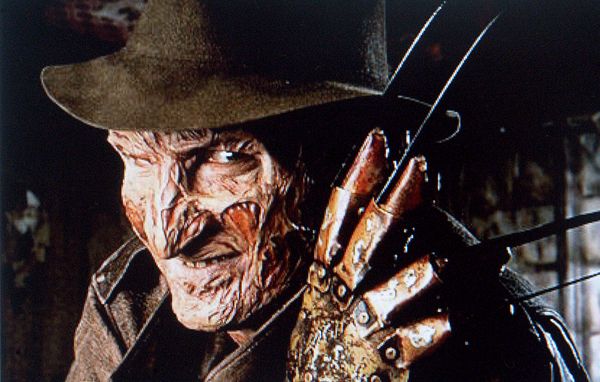
By the same token, when you sit down to write something “scary,” it can help to know just what you’re hoping to accomplish. People get their heads cut off in the Saw movies, in Attack of the Clones, in The Man in the Iron Mask, and in A Mighty Heart, but these decapitations are all received in very different ways because of how their particular stories are being told. In the same way, Freddy Kruger has been a slasher, a monster, and a plain old villain, even though the character has barely changed at all. How, exactly, do you intend to scare your readers with this moment as opposed to that one? Or are they supposed to evoke the same kind of fear?

You can nitpick back and forth, but I think fear, as a sensation, generally breaks down into three basic categories. There’s a couple different names people use for them, but for our purposes today, let’s call them the shocker, the gross out, and dread. These three form the food pyramid of fear, if you will, which means using and combining them in the right ways can make a variety of tasty seasonal treats.

…starting to sound like a cooking blog…

Anyway…

The Shocker This is when something unexpected happens and makes the audience jump. It’s the fear of what’s happening right at this moment. If you’ve ever watched someone read and seen their eyes bug, they probably just hit a shocker. Ever been in a theater when most everyone screams? Same thing. When someone walks around the camp cabin and Jason buries his machete in their skull, that’ll make you jump even watching a movie where you know people are going to get machetes in the skull. When Michael suddenly shoots Ana Lusia on LOST, that’s a shocker, too. Individual shocks can be stretched out a bit–especially on film– with lots of shouting and chaos and a few smaller shocks to keep it going, but really a shock is a short-lived thing.

The shocker is powerful, but it’s important for writers to remember it can’t stand on its own for long. As I’ve mentioned before, a good way to think of shocks is like exclamation points. You can use them! You can use a lot of them!!! But after a while, there needs to be something that actually requires emphasis! If not the shocks will start to lose power and your readers or audience will start to get bored!! Shocks eventually need something solid and lasting to support them.

The Gross-Out As named by the King himself. It’s when things are just disgusting. This is when the writer’s trying to tap into the reader’s sense of revulsion and maybe even induce some nausea. It’s when we spend two or three pages on someone getting their limbs sawed off or just eating a peanut butter and maggot sandwich, where the little sour-milk colored larva are eating their own paths through the spread before getting crushed against the roof of the mouth by someone’s tongue. The gross out usually differs from the shocker because of duration. While a shock gets weak the longer the writer tries to prolong it, a gross out can actually gain strength as it goes on and on (and thus, torture porn was born). Go too long or too frequently, though, and audiences will get bored with the gross out just like anything else.

An interesting point is that the audience often (but not always) knows the gross out is coming. We don’t linger on it, but it rarely comes out of nowhere.

It’s also worth noting that a lot of gross-out stuff moves closer to dread when it isn’t described at length. Speaking of Stephen King, we all remember the lovely “hobbling” scene in Misery, yes? What’s happening almost takes second place to Annie calmly explaining what she’s doing and why she’s doing it… even in the middle of the procedure.

Dread This is when something doesn’t happen, but we know it could. It’s fear of potential events, if that makes sense. You could also call this suspense or perhaps terror (if you wanted to nitpick). We’re waiting and waiting because we know something’s going to reach out from under the bed or crawl out of the closet and the fact that it hasn’t yet is giving us the chills. Pennywise the Clown gives us anxiety because we know he isn’t just a clown and it’s very wrong for him to be down in those sewer drains. Hannibal Lecter is creepy just sitting in his cell talking about the things he’s done in the past. And the zombie Julie Walker is kind of hot, but you also know she’s on that razor’s edge of probably eating everyone in the room (and not in the fun way). Dread works well in larger tales because there’s space for eerie backstories, but a good writer can also make it function in tighter spaces.

There’s two catches that come with dread. One is that it relies on the writer having a very solid grasp of how the audience is going to react and what they’re going to know. If I tell you there’s a Strigori knocking at the front door, most of you are going to shrug your shoulders and open up. Likewise, I may find ketchup disturbing, but I shouldn’t assume everyone’s skin is going to crawl at the sight of it. Paint the creepy stuff on too thin or to vague and the audience just won’t get it and they’ll be bored. Paint it to thick and they’ll be angry you assumed they weren’t going to get it. If the shocker is a hammer, suspense is the scalpel of fear.

Tying back to that, dread also relies on the audience having… well, not to sound crass, but it depends on a certain level of intelligence and involvement. If you try explaining climate change to a chimpanzee, you’ll notice they don’t get too worried about it–assuming they sit there for your whole lecture. It makes me sound old, I know, but part of the challenge with dread these days is the shortening of people’s attention spans. If people keep switching channels, walking away, twitting, or texting, they’re not getting involved in the story. Without that involvement, it’s very hard to build a sense of dread.

Also worth noting that dread needs good characters more than the other two types. We need to be able to identify with what a character’s going through. If we can’t, this is a news report, not a story.

Once you know just what you’re trying to do, it’s easy to see how each one works and how they can work with each other. Campfire stories are often little suspense tales that build to a shock in the same way jokes build to a punchline. A lot of the ‘80s slasher films would start with a touch of suspense, jump to shock, and then dive headfirst into the gross-out. Alfred Hitchcock could drag suspense out for ages, but knew a good shock or two could make a film unforgettable.

(mother, please. I’m trying to work on my blog. No mother, it’s not one of those websites, it’s for good people…)

Anyway…

Next time is mostly for the budding screenwriters. Some of you found out last week that you didn’t get one of the 2010 Nicholl Fellowships, yes? I’m willing to bet that no one reading this did, but I’m also sure some of you didn’t try for one. Let’s talk about why you didn’t get one.

Until then, go hand out candy. Oh, and write between trick or treaters.

Categories