I’m off at San Diego Comic Con all week, doing all sorts of stuff, but I still wanted to have something here (I’m assuming not all of you are going to be at SDCC with me).  So I figured I’d roll out something I’ve been saving for a special occasion…
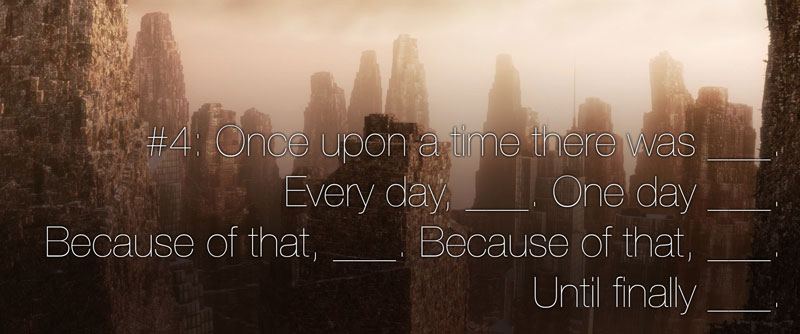
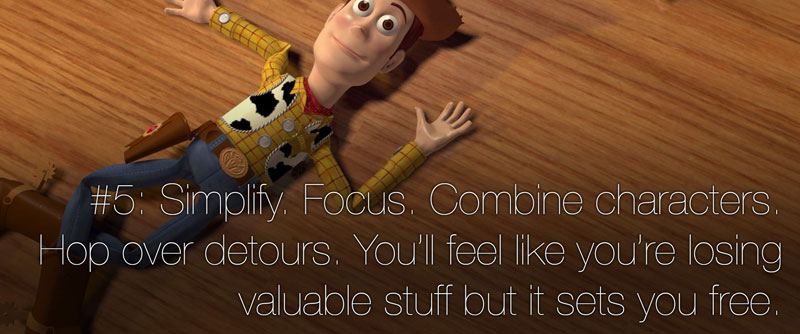
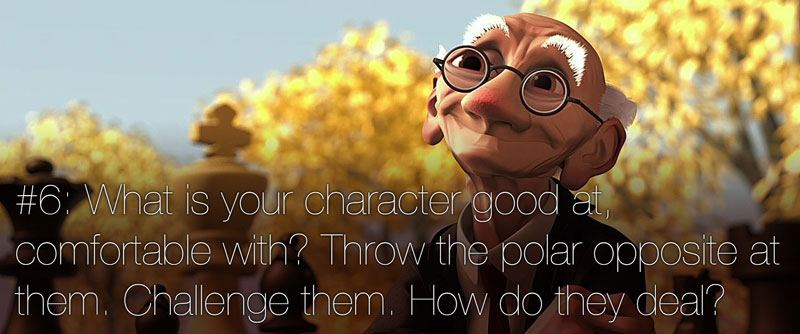
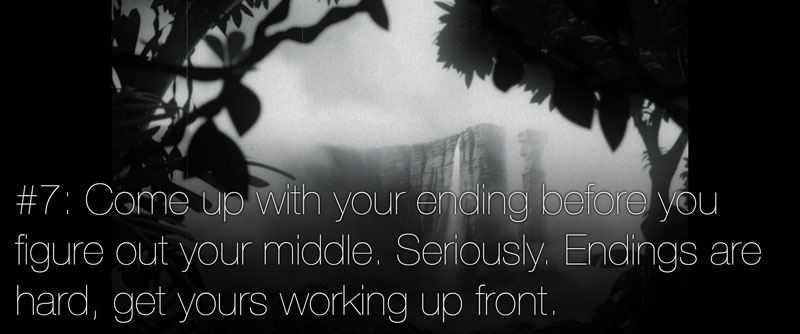
            A few years back, a story artist at Pixar named Emma Coats took all the various tips and hints and suggestions she’d heard during her time there and boiled them down to 22 rules.  I’ve seen them presented a few different ways over the years (including a free poster available on Pixar’s website), but this particular one struck a chord with me—somebody memed them.
            (And I’m ashamed to say I don’t know who.  I first ran into them on a website, but an image search just turned up… a lot of websites.  So if anyone can figure out who actually deserves credit, please let me know…)
            If you happen to be at SDCC, please find me somewhere and say “hi.”
            If not—here’s some rules for you…

May 27, 2017 / 1 Comment

Feet of Clay

            Sorry I’m running late again. I seem to do that a lot, don’t I…?
            I was going to do a whole piece on character building this week (since nobody suggested anything else). But it kind of felt wrong.  We talked about characters at the Writers Coffeehouse this month, and we’re going to talk more next month, and I always feel a little odd addressing Coffeehouse topics here on the blog. Especially close to the same time.
            Yeah, not everyone here goes to the Coffeehouse, but still…  One way or another, it feels kinda cheap.  To me, anyway. It’s just how I’m wired. Like I’m re-using material here or there, giving one group minimal effort.
            But while I was writing out the character piece, I thought of a new angle I wanted to explore.  The more I thought about it, the more I was sure it could be a post all on its own.  A new take on character development.
            So, here’s an easy question I should be able to answer about any of my characters.
            What are they not good at?
            Seriously.  This shouldn’t be hard. Can I name five or six things my character isn’t good at?  No, not ridiculous things like “gene splicing” or “space shuttle repair” or “aboriginal dialects.”  Just name a couple basic things your character isn’t good at.
            Let me make it personal. 
            I’m terrible when it comes to pretty much any kind of sports.  I don’t know players, teams, leagues, anything.  I can name a few New England teams, just because I grew up there, but even then I’d be pretty pathetic.
            I wish I was more musical.  I love music, but have never been good at music, if that makes sense.  Horrible at telling music genres/styles apart, can’t play anything more complicated than a triangle.  Hell, in high school I played bass drum in the marching band, and a couple people can vouch for the fact that I screwed thatup sometimes.
            I’m really bad at taking compliments, on any level.  People telling me I have nothing to worry about is pretty much guaranteed to freak me out.  I’ve been a full time writer for ten years, my ninth novel is coming out this year (plus the new collection this week) and I still have a ton of career anxiety.
            Anyway, I could go on and on, but you get the idea, right?  I’m not a perfect person (not by a long shot).  Most people aren’t.
            And, if I’m doing it right, my characters are people too. So there should be things they’re not good at.  They should have bad habits that cause problems.  There should be fields of interest they know nothing about.  Blind spots to political/cultural ideas.  Phobias that mess them up.  You’ve probably heard of these referred to as character flaws.  It doesn’t mean there’s anything blatantly wrong with the character.  It just means they’re… well, human.
            If I’m doing this writing thing really well, these areas where my characters have problems are going to cause specific issues in this story.  Maybe even a few plot points will hinge on them. And my characters are going to have to learn and grow and change to get past these problems.  They’ll have to make an effort to overcome fears, work past prejudices, and maybe figure out new ways of doing things.
            That’s a good thing.  It’s called a character arc.  You’ve probably heard of those, too.
            Now, let me address a couple of quick points, if I may…
            There are those folks who believe, well, more is better.  Their characters don’t have a flaw, they have flaws. And they don’t really have flaws, they have faults.  And I use “faults” in the geologic, California-drops-into-the-Pacific sense.  Yawning, bottomless chasms.  Each character generally has six or seven of these.  Maybe a baker’s dozen.  These people don’t just have feet of clay. They have feet, ankles, calves, knees, thighs. hips, groins, and lower abs all made of wet, soft clay. 
            Yes, groins.  There’s no way someone this screwed up doesn’t have a ton of sexual issues.  That’ll come up, too.  Or… maybe it won’t. One out of five…
           Again, this isn’t unrealistic.  I’m willing to bet most of us have known one or two really messed up, annoying people in our lives.  I’ve known a couple.
            As I’ve often said, though—reality isn’t our goal as fiction writers. Think of that messed up person from your own life. How much time did you really want to spend with them? Would you want to read a short story about them? A whole novel? Sit through a two hour movie?
            Y’see, Timmy, there’s nothing wrong with an overly-flawed character, but I need to balance that with the realization that my readers need a reason to like this person. A reason to keep reading.  It doesn’t matter how beautiful or artistic my prose is, the majority of people aren’t going to want to read about an awful character who’s a failure on every possible level.  
            If someone’s going to have serious flaws, they need some serious strengths, too, to counterbalance them.  A grocery clerk who gets blackout drunk every weekend to forget her past isn’t that interesting, but a popular billionaire philanthropist who gets blackout drunk every weekend to forget her past… well, that probably got you thinking of story ideas right there, didn’t it?
            Also, to got to the other extreme, nobody likes the flawless character. Seriously.  I’ve talked before about some of the problems with characters who are never caught off guard or never get scared.  What’s the challenge going to be for someone like that?  If Dot is always ready, always prepared, always calm, and always wins (of course she always wins—how could she lose?)… well, that’s going to get boring really quick.  And unbelievable.  When somebody’s ready for absolutely every contingency—especially when there’s no real reason for them to be—it just gets ridiculous.  Plus, there’s no space for character growth. If I’m already at ten in all categories… what kind of arc can I have?  Where can I go?
            There’s a wonderful line in the first Hellboy movie—“We like people for their qualities, but we love them for their defects.” I think that’s extremely true of fictional characters.  The more well-rounded they are—with strengths and weaknesses—the more we’ll be able to identify with them. And care about them.  And want to read the next book about them.
            Which is what we all really want to happen.
            Next time…
            Okay, look, I’ll be honest.  Next week’s my birthday.  There’s a good chance I’ll be drunk the entire day.  Possibly the night before, too.
            But… if I manage to be sober somewhere in there, maybe I’ll talk a bit about shutting up.
            Until then… go write.
February 9, 2017

Love Is All You Need

             Yes, it’s that time of year again.  The time when a young writer’s fancy turn to thoughts of…
            Well, getting published, usually.
            But, that aside, there’s romance in the air this weekend.  And everyone loves a good romance because, pretty much across the board, we’ve all either been in love, are in love, or want to be in love. It’s a wonderful feeling.  Heck those first few months of giddy romance are just fantastic, aren’t they?
            Love is great because we can relate to it.  We believe in it.  For the most part, we enjoy seeing other people in love.
             (except when Wakko started dating Phoebe… those jerks… hate them so much…)
            If those three traits sound familiar—relatable, believable, likable—it’s because I’ve mentioned them two or six times as the traits of good characters.  So a good romance can be a powerful tool in a story, because it immediately grounds one or two of my characters.
            However…
            Have you ever read a book or watched a movie where, with no warning, two characters start professing their mad love for each other?  No preamble, no chemistry, they just suddenly  start flirting and making long-term plans.  None of us likes emotional fakery, and few things can sink a story faster than a pasted-on love interest.  It makes us roll our eyes while reading books and laugh while we’re watching movie.
            So, let’s revisit a few simple rules that can help craft a love story for the ages…
            The First Rule—  Okay, like I was just saying, love needs real emotions, and I can’t have real emotions without real people.  And real people, oddly enough, act in realistic ways.  Note that I said realistic—not rational.  Love is one of the most bizarre, irrational things most of us will ever encounter in our lives. 
            If my characters are real, though, they’re going to have needs, desires, plans, and tastes.  And it’ll stand out if they make choices that go against those traits.  Yes, opposites attract—they even have a lot of fun together—but if we’re talking about real emotions, odds are these two are going to have more in common than not.  To put it another way, the career-minded Army officer probably isn’t going to make serious long term plans with the quirky socialist musician.  Although… maybe she used to play guitar or violin, and he reminds her of another path she could’ve taken.  Having past conflicts and secrets can make a character seem real, too.
            Even then, how far and how fast they take things should be consistent.  Some folks schedule every hour of every day, others live in the moment.  People can be confident or nervous, experienced or awkward.  For some folks it’s a huge moment to have that first cautious, fleeting kiss on the third date, and other folks are in the parking lot tearing each others clothes off half an hour after they meet.
           Simply put, my characters need to be believable if their relationship is going to be believable.

            The Second Rule—  Quick show of hands.  Who’s ever been in a situation where someone’s been trying to push you into a relationship?  Maybe it’s friends or coworkers.  Could be the person you’ve been on one date with.  Hopefully it’s not relatives, because that’s always kinda… weird.
            Regardless, the result is it makes us want to get away from the object of our potential affection.  Nobody likes feeling forced into something, and so we don’t enjoy seeing other people forced into things.  That’s just human nature.
            Now, for the record, “someone” includes me, the writer.  Characters need their own motivations to get into a relationship.  I can’t just have them do things for the convenience of the plot.  If I’ve based my whole story around the folklorist and the soldier saving the villagers because of their mutual respect for each other, then I need a real reason for them to get together, because they’re real people (as mentioned in the First Rule). 
            And no, the reason can’t be something like “because they need to face Demosthenes the Elder-Lich in the third act.”  It also can’t be “I need a sex scene to hold people’s attention.”  If this is the basis of Wakko and Phoebe’s relationship… well, they probably won’t be celebrating any major anniversaries.  Not with each other, anyway.
            People get together because they want to get together, not because other folks think they should be together.

            The Third Rule – This one could actually count as real-world advice.  Don’t confuse sex with love.  There are lots of points in a story where it might be completely acceptable for two characters to have sex.  We’re all mature adults here (well, mostof us) and I’m willing to bet most of us have had sex with someone we weren’t madly in love with at that moment.  Or at any point later.  Simple fact—sex is fun.  It’s a stress-reliever.  It lets us avoid thinking about other things.  Heck, it can even keep you warm.
            However… sex doesn’t always translate to love.  In stories or in the real world.  If my two characters fall into bed (or onto a couch, up against a tree, on a kitchen counter, etc), I need to make sure I’m clear what it means for both of them.  Forcing something casual into something serious will just read as forced (refer back to the Second Rule).
            So… sex and love are not the same thing.  Don’t forget it.
            The Fourth Rule— This is a tough one, because Hollywood keeps trying to tell us otherwise.  How often in movies can you immediately spot “the love interest” as soon as s/he is introduced?  It doesn’t matter what kind of film it is or what’s going on, it’s easy to pick out him/ her the first time we see them.  You may have heard this moment called the “meet-cute,” usually in screenwriting circles.
            Y’see, Timmy, the simple truth is…  romance doesn’t always fit in a story.   Someone could be fighting for their life, painfully wounded, or so scared they’re a moment away from a heart attack.  Maybe they’re already in a relationship with someone else.  Maybe they just have no interest in a relationship—emotional or physical.
            Forcing a relationship in these situations also risks making one or both characters seem very unlikable.  There was a television show a few years back where a police officer was presumed dead and in hiding, but kept sneaking off (in his new identity) to check on his wife and son.  Thing is, he was also spending a lot of time with this sexy blonde contortionist (no, seriously) and there was a lot of, shall we say, tension between them.  And chemistry.
            Thing is, this made the officer a very hard-to-like character.  Is he cheating on his wife?  Or has he moved on and found something new?  Is he sympathetic or a heel?
            Similarly, I read a screenplay once where the two protagonists start feeling strong urges toward each other while they’re searching for the woman’s abducted daughter.  Not years-back abducted, mind you—four hours ago abducted.  But, wow, doesn’t this private detective have great arms and his eyes are soblue…
            In ten words or less—sometimes it’s just not going to happen.
            So there are the rules.  Now go forth and spread the love.
            Where appropriate.  Don’t be that guy.  Or woman.
            Oh, and before I forget, this Sunday is the Writers Coffeehouse at Dark Delicacies in Burbank.  If you happen to be in the Los Angeles area, please swing by and join us as we talk about writing, publishing, and all the different areas they overlap.
            Next time we’re back here, I’d like to talk to you about a couple of ideas I’ve had.
            Until then, go write.

            If any of you happen to follow me on Twitter, you know I have a habit of watching bad B-movies on the weekend–usually while I’m geeking a bit.  While I do, I tweet out random observations about the story, dialogue, plot points, and so on. More often than not… they’re not positive ones.
            There’s usually a lot of drinking going on, too.

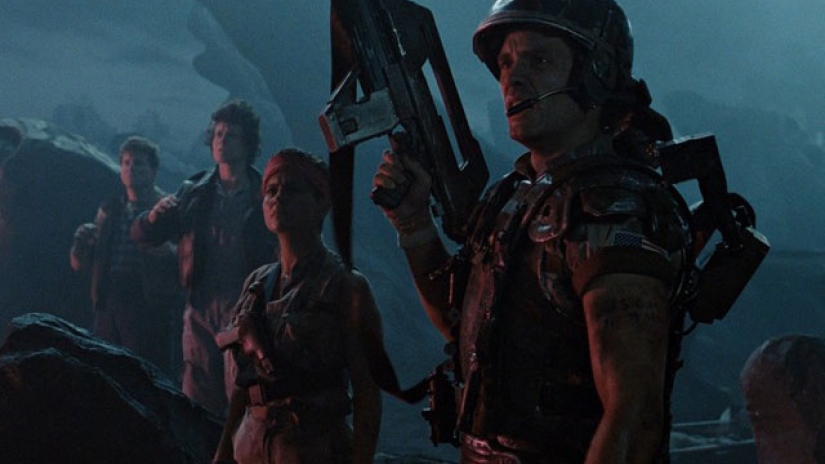
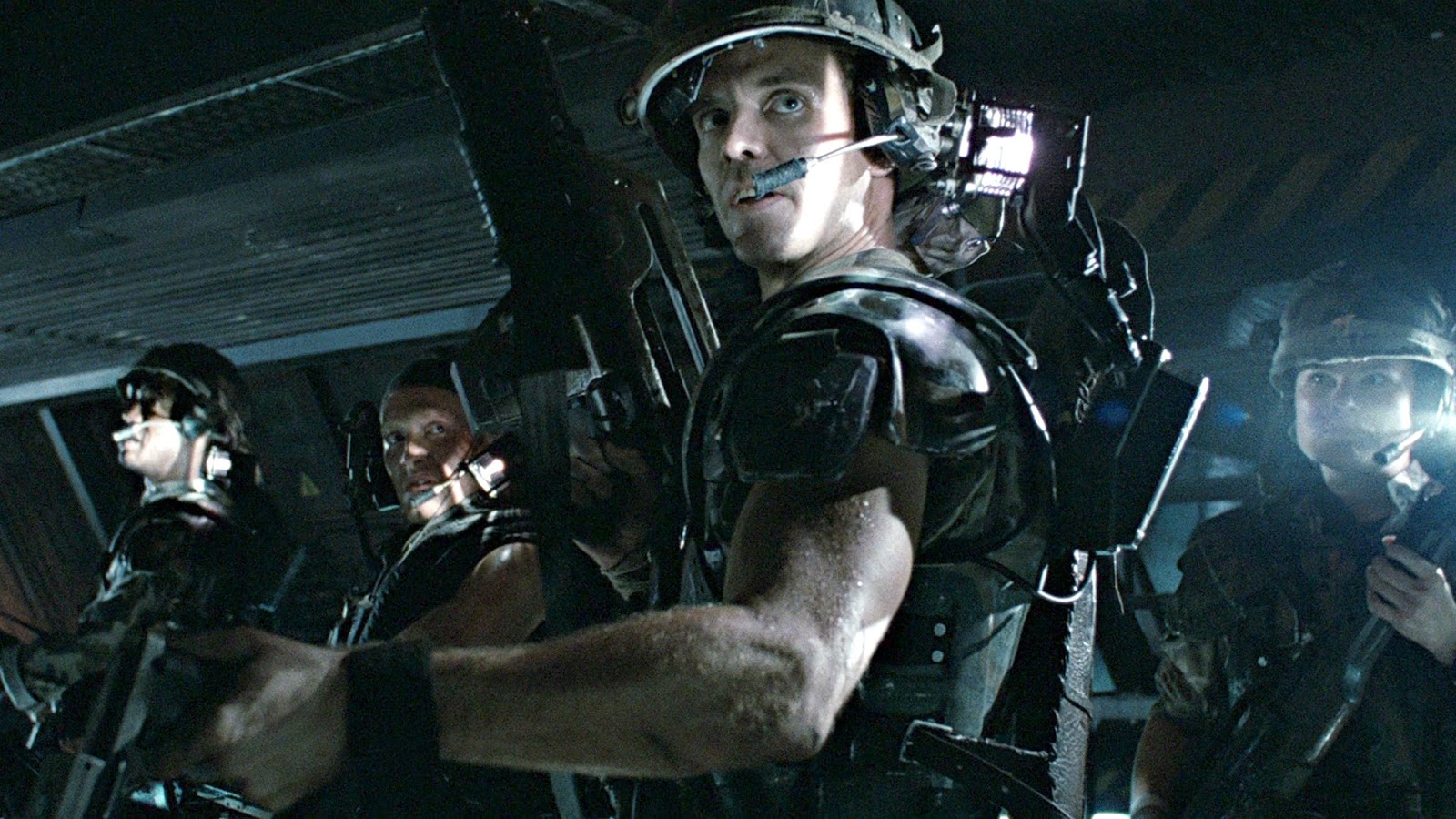
             A few weekends back I was watching this movie that went for the standard “group of assorted soldiers thrown into an unnatural situation” scenario.  The same one that’s been kind of become the standard since Aliens did it with the Colonial Marines.  Often copied, never duplicated, as they say.

            Maybe twenty minutes in, one of the civilians asked a grunt why they were all so dedicated to the sergeant.  And said grunt told him this two or three minute story about how, five years ago, they’d been stationed on Theta Sigma, things went belly-up one night on patrol, and Sarge was the only one who kept it together.  He got them out of that hell-zone on the death planet, and he even carried Bronsky for the last three miles.
            Then, maybe thirty five-forty minutes in, one of the civilian scientists asked the lieutenant why he was such a hard ass.  And he told her about how four years ago he’d been walking the perimeter, checking on his men, and he found some civilians in a restricted area. But he cut them some slack… and then the Lictors attacked. If he’d been hard then, if he’d sent them away as soon as he found them, those three people’d be alive today.
            And then someone sat with the Sarge for a while as he recovered from a wound (he’d been impaled right through the chest, and that put him off his feet for, y’know, almost six hours).  She asked how he could stay so positive, making jokes while the whole mission was turning to crap around them.  And he told her about how, seven years ago, he’d been on this bug hunt on Ceti Alpha Five…
            Look, you get the idea, right?  Do I really need to finish that story?
            Yeah, most movies don’t do it that many times, sure.  Still… that element’s kind of become a standard in a lot of military stories, too, hasn’t it?   The soldier/Marine/Amazon/Mooncop who gives us a flashback in dialogue to explain a strange bond, a weird character tic, or maybe even that scar she’s got that runs from her temple down past her jaw. 
            Here’s the funny thing, though. This never happens in Aliens.  Not once. Not even for a few seconds.
            Y’see, Timmy, in Aliens the story only goes forward. We don’t need to go backwards to learn interesting stuff about these characters.  We’re learning about them through how they react to things now, not how they reacted to them six years ago in Kazakhstan.
            If the only way I can make my characters interesting is by flashing back six or seven years… maybe I don’t have interesting characters.  Not now, anyway.  It’s possible they were interesting back then, but if they’re interesting now… why’s all their character development in the past?
            At the very least, I don’t have an interesting story.  If I did, wouldn’t there be  cool stuff happening now?  Stuff my characters could be reacting to and giving the reader a better sense of who they are, even as it drives the plot and story forward?
            If it’s only that recollection or flashback that’s making them cool… maybe that’s the story I should be telling.
            Anyway, just wanted to toss that out real quick.
            Thursday, our regularly scheduled post.
            Until then, go write.
Categories