
April 8, 2011

The Back Seat Driver

Many thanks for your patience. Sorry I had to miss last week. It’s for a good cause, trust me.

I’m sure you’ve all heard that titular term before, yes? Most of you have probably experienced it at one time or another. It doesn’t even need to be in the car. There are folks who can be backseat drivers in the kitchen, at work, and at school. And definitely on the internet…

If you’re not familiar with the term, a backseat driver is someone who’s not behind the wheel, yet continues to tell the person who is what they should be doing. It’s not all that far off from the old chestnut “those who can’t, teach.”

I’m sure you’ve also all heard about plot-driven stories and character-driven stories. They’re terms that get applied to tales where the focus is either the characters or the plot. Summer blockbusters and best-selling “beach books” tend to be thought of as plot-driven while slow-paced indie films and more “literate” books are often considered to be character-driven.

Now, personally, I don’t think there’s any such thing as a plot-driven story. All stories are moved forward by the actions (or inaction, in some cases) of their characters, thus all stories are character-driven. I think it’s one of those cases where a shorthand term developed which then somehow became a mild pejorative. The usual implication is that if you have a plot-driven story you have crap characters who are flat on the page. That’s why you’ll often see people refer to (for example) “a character-driven horror story” or some such, because the implication is this was just a horror story, or (heaven forbid) a plot-driven horror story, it couldn’t be that good. Being character-driven validates a work, while being plot-driven invalidates it in some way.

Plot-driven generally gets used as a pejorative because it’s a common way stories get messed up. Some writers (or in the case of Hollywood, some development execs, directors, and actors) get so obsessed with individual beats and moments they forget the overall whole. Explosions are cool, but explosions that serve no purpose are just silly. Emotional monologues and character reversals are fantastic, but when they happen at awkward moments with no motivation behind them… well, then they’re laughable. When the story gets twisted to accommodate these things, it tends to get considered plot-driven. I have a list of plot points and I’m going to hit them no matter how bizarre, pointless, or crammed-in they feel.

But back to my driving metaphor…

Plot has to take a back seat to characters. As I’ve said here many, many times before, characters have to be your priority. If I can’t believe in Wakko and Yakko, their story’s dead on arrival. I need to accept their motivations, actions, and reactions. If characters act in an unbelievable way, it doesn’t matter what’s going on around them. Good, well-developed characters must be the driving force in a story.

I’m not saying plot isn’t important, and I’m sure as hell not saying you don’t need it. Anyone who’s been following along here knows how much a story with no plot drives me nuts. But at the end of the day, your audience is going to notice an unbelievable character over an unbelievable situation. So if you know your characters are good, you need to tweak the plot to suit them, not vice-versa.

In all fairness, I’m also guilty of this particular sin. I’ve done it before, I still do it today sometimes, and odds are I’ll do it again sometime in the future. Keep this little fact in mind for your summer reading–the final climactic day in Ex-Patriots was originally two days. Yep, right in the middle of all that’s going on in the last ten chapters, people stopped and went to bed for the night. Seriously. Is that lame or what? Fortunately I recognized that sticking this rigidly to my roughly-outlined plot was injuring the story as a whole and forcing my characters to act unnaturally.

Now, with all that being said, reality has to take a back seat to plot. And we’re out of back seats, so reality has to go in the trunk. Yeah, we could be in a limo or something, but the importance/ seating order is kind of reversed in a limo. That just messes up my beautiful metaphor.

Anyway, at the end of the day, people are reading your work for a good story, not for an education. Anyone who’s reading Dan Brown for an insightful and true view of the Renaissance is in for a major disappointment. Thomas Harris may not be the number-one source for how FBI profilers act. I just had a discussion with a publisher about brain structure which ended with us agreeing my words will sound pretty good to most folks, but hopefully any neurologists will be willing to suspend disbelief a little more than the layman.

You don’t want to bring a really cool plot to a crashing halt by rigidly adhering to facts. You don’t want to be blatantly wrong, but you’re also not writing a textbook. Well, maybe you are, but then most of this doesn’t apply to you. How many phenomenal movie gun battles would lose a lot if the filmmakers counted every bullet and showed the hero reloading again and again and again? If it took nine days for a steamship to cross the Atlantic but I say my Victorian heroine has access to a ship that can do it in seven, is that going to upset anyone?

Well, yes… there’s always someone on the internet who will feel the need to write an essay about the ludicrous degree to which I’ve massaged the facts. Can’t be helped. Just take that one as a given and move on.

I got to hear Ray Bradbury tell a wonderful story once about how he was hired by the Smithsonian to spruce up the script for their failing planetarium show. Their show, he immediately realized, was a dry recitation of facts rather than an exploration of the wonders of the universe. When he turned in his version, he got back a list of notes that was longer than the script itself–and every note was replacing one of his poetic exultations with another rigid, precise fact and an explanation of the fact. When they challenged Bradbury’s statement that the universe was over fifty billion years old, he dared them to prove it.

“So they fired me,” he said gleefully, “for being a smartass.”

And another planetarium happily bought his script.

So… the characters are driving. The plot is in the back seat where it can offer suggestions if need be. Facts are in the trunk–we know right where they are if we need them and they can be heard if they yell really loudly.

Make sense?

Next time I’d like to talk to you about Jenga. Yeah, Jenga. The wooden-blocks game. Trust me, it’ll be cool.

Until then, hit the road. And go write.

March 25, 2011

All Good Things…

I just finished reading a trilogy co-written by a legendary sci-fi author. I’m betting it was more like “casually glanced at by,” but I guess we’ll never know. The series started out amazing, but got weaker and weaker as it went on. The final chapter randomly introduced a character who’d been mentioned once or twice and never seen. To be honest, it introduced the future/ adult version of this character. It also introduced a new setting, a new terminology, and an entire war that kind of came out of nowhere.

Cymbal crash.
Confused? Yeah, so was I. That was the end of the last book. The final line was “Cymbal crash.” I think it might be a reference to Kubrik’s 2001: A Space Odyssey but I’m not 100% sure on that. Needless to say, it didn’t leave me with a good feeling about the series.
Likewise, a few weeks back I saw a low-budget film loosely based on H.P. Lovecraft’s horror stories. It had some real structure problems and the tone was all over the place. But it had a solid ending and the final scene knocked it out of the park, so I’ve recommended it to a few people.
An ending can make or break a story. They are the dessert after a feast of words. You can have the best filet mignon in the world with an exquisite wine, but if the cheesecake is slimy and bitter… well, you’re going to be walking out with a bad taste in your mouth. A so-so film with a phenomenal ending will usually get favorable reviews. A strong manuscript that spirals downward at the end will, more often than not, be tossed in the large pile on the left.
Now, while some folks are content to say “well, that sucked” and leave it at that, a storyteller has to know why something doesn’t work. Bad endings don’t all have the same root problem. Sometimes the writer had a phenomenal way to start a character arc, but wasn’t sure how to wrap it up. Or it can happen when people have a really cool idea for a story, but don’t know where to go with it past that initial idea. Sometimes an ending just doesn’t work with the rest of the story. Some endings almost never work, no matter what the rest of the story is.
Note that I said almost never. As I go over this list of failed endings, you’ll probably be able to name some books or films that use them very successfully. These endings are exceptionally difficult to pull off, though, and should be approached with extreme caution…

Nothing Changes—Let’s start with the basics. If the first fifteen pages and the last fifteen pages of a manuscript show characters in the same place, doing the same things, with the same people, and they’re not any wiser for the experience… Well, that wasn’t much of an experience, was it? For them and probably not for the readers. I’m not saying characters need to have some big emotional breakthrough or spiritual growth. There has to be something notably different, though, or this was just more wasted time.
One type of story that does this a lot is the “slice of life” tale. Just two or three average days in the life of two or three average people. Now, yes, most of our lives don’t change radically in any given moment. I’ve spent most of today here at my desk writing, just like I did yesterday and probably like I’ll be doing tomorrow. So it would be a truthful ending if a slice of life story about me had me back here at my desk.
The question you need to ask yourself is… why would anyone want to read about that? I know I sure wouldn’t. I go through a slice of life every day where nothing changes. I want to be entertained!

…And They Write a Book/ Screenplay About the Experience—I’ve mentioned once or thrice before that this is pretty much the worst ending you can have for a screenplay. It isn’t much better in a book. This is almost always a tacked on ending to assure the reader that the protagonist didn’t just survive this story—they benefited from it. Immensely. Yeah, you would think kicking drugs, reconnecting with the family, and getting the girl/boy would be enough for most folks to consider it a good week, but noooooooo… according to some writers they need acclaim and wealth and celebrity, too.
In my experience, writers tend to fall back on this ending for one of three reasons (sometimes more than one of them). One is that it falls into that silly “write what you know” tip we’ve all heard for years and years. Two is a desire to add that patina of reality to the story, thus making it more valid… somehow. Three is that it’s sort of a wish-fulfillment validation. My character writes a book about how she used to be a crack whore and it becomes an acclaimed bestseller. So, logically, my story about a character writing a story about how she used to be a crack whore should also become an acclaimed bestseller.
That there’s crazy-person logic is what that is…

Everybody Dies and the Antagonist Wins—One of the biggest problems with wrapping things up this way is it gives the reader a sense that the story was pointless. They’ve just invested a few hours (or perhaps days) of their time into this tale only to see it come to an unpleasant ending. This can be especially frustrating if the reader comes to realize the character never had a chance at accomplishing their goals. It’s even more frustrating if the characters made some foolish decisions somewhere along the way. After all, it’s bad enough when you have to watch the fifth person in a row walk through the archway marked Painful Death, but when that’s the point the writer chooses to end the story on…?
I know. It’s hard to believe that after centuries of storytelling this is still considered an unsatisfying ending.
Your protagonist doesn’t need to come through unscarred, mind you. Heck, you can even get away with killing your lead. But they need to win on some level.

The Left Fielder—Called such because it’s the ending that comes out of nowhere. The business-obsessed dad gives up his career to care for his senile mother, but then she falls in the pool and drowns. The wallflower finally gets her act together, aces her exams, gets the quarterback, is voted prom queen, and then gets hit by a bus on the last day of school. Or, as I once experienced, a ninety minute sketch comedy show which climaxes with a bleak monologue about racial inequality and prejudice.
No, seriously. I worked on a play like that once. The director rewrote the end and honestly couldn’t figure out why no one liked it.
In my experience, the vast majority of writers who use this kind of ending are trying to achieve ART. It’s an attempt to show how perfectly this story mimics a random and sometimes meaningless real world by having a random and meaningless ending. It doesn’t relate to anything that happened because it’s too real. And tragic. And artistic.
Besides suffering from all the same frustration issues as the previous ending, the left fielder just isn’t that special anymore. It’s become one of the most common conclusions in indie films and “literature.” So besides exasperating an audience, it’s an ending they’re probably going to see coming for the simple reason it wouldn’t be what they’d expect.
There is nothing wrong or pedestrian about putting the right ending on a story. As I’ve mentioned before, nobody got hit by a train at the end of Slumdog Millionaire and it was still a good film.

The Y’see Timmy—I use this phrase here a lot, and it’s a bit of an homage to the film that I got the term from. This ending gets its name from the old Lassie television show. Little Timmy would encounter some problems, work his way out of them, and at the end Mom would sit him down and explain what happened and why. “Y’see, Timmy, sometimes people get hurt inside and it never heals…” Timmy and the audience learn a little something about life and we all go home as better, happy people.
Alas, in inexperienced hands the Y’see Timmy quickly becomes “beating your audience over the head.” If you’ve ever made your way through Ayn Rand’s Atlas Shrugged, you probably remember the 98 page monologue at the end which recaps every one of the subtle lessons that were shown in the first 800 pages of the book. You also probably ended up skimming the monologue, just like everyone else did.
If the moral of the story is clear, do you need to explain it to your audience again? If it isn’t that clear, then the problem isn’t your ending, is it?
If you’ve never seen it, go watch Speechless (written by Robert King) and you’ll see Michael Keaton do a fantastic job explaining this idea to Geena Davis. It’s how I found the term. Plus it’s just a fun movie.

The Wedding—There are a few reasons weddings can make folks yawn at the end of a story. First, it’s ridiculously common. Much like the artsy Left Fielder, so many writers end their romances or rom-coms with a wedding it’s become the default, which means it’s far too common to use in any other genre. A wedding also draws attention to the timeline in a story, which is not always a good thing. It can either emphasize that these folks are getting married less than a month after meeting each other, or it can point out that the narrative just skipped seven or eight months between pages, which means it’s just tacked-on to give the ending a bit more uumphh (as they say).

It Was All a Dream—Probably the worst offender here. All too often the amazing tale of adventure ends with one of the heroes waking up on the couch or in a hospital bed. No, none of the story the audience has just invested their time and attention in really happened, not even in the world of the story. We all just put ourselves into a story about a person who was putting themselves into a story.
Now, there was a time when this ending was fresh and bold and caught people off guard. That time was 1890 when Ambrose Bierce first sold his short story “An Occurrence at Owl Creek Bridge.”
In the 121 years since then, this ending’s been used once or thrice in literature and about a billion times since the creation of the sitcom. Heck, there are old Shadow radio plays that use this device. As I mentioned above with Everyone Dies, this just tells the reader they made an investment for no reason. Was there anyone who went to see Click who didn’t immediately say “it’s all going to be a dream!!” the moment Adam Sandler stretched out on that Bed Bath & Beyond display? Think about it—this is such a common ending it’s easy to spot the moment the dream begins.
So, there they are, a few endings that were overused years before Edgar Rice Burroughs or Ray Bradbury decided there might be something really cool up on Mars. Like many of the tips I toss out, I’m not saying it’s impossible to do one of these. It is very, very difficult, though, and you may want to think twice before tackling one of them.
Next time may be a bit late because I’ve got a deadline I need to hit. But when we do get together next, we’re going to go for a little drive.
Until then, go write.
March 18, 2011 / 2 Comments

Lucas Syndrome

On the very, very off chance you didn’t know, George Lucas was the writer/ director/ creator of a little seres of movies that went under the header of Star Wars. They sold a ticket or three at the box office. I heard there were even one or two spin-off toys.

Okay, I used to own a bunch of the spin off toys. Almost all of them. Except for the blue Snaggletooth. And the Bespin Leia, who had a weird-looking tiny head.

Anyway…

The first trilogy did very well, as I mentioned. It made tons of money and inspired a whole generation of storytellers to pick up pen, pencil, or home video camera. There was a great piece I read years back about when John Williams created the new Star Wars orchestra for the prequel movies. There were half a dozen musicians in it who had been part of his original orchestra twenty years earlier. It also had about a dozen younger musicians, all of whom had gotten into classical music because they were inspired by Williams’s score from the original trilogy. And now they were all working on the prequels.

Ahhhh, the prequels.

The prequels were not quite as well-received. Oh, fans were in a frenzy at first. I know. I was there in the line at Toys R Us for the special midnight releases. After the first movie, though, that energy ebbed a bit. After the second movie it was leaking away. By the final film, the fan base was bleeding out, to turn a phrase. There were still some die-hards, but there were far more shrieking about how Lucas had “raped their childhood.”

So, what went wrong?

Well, you could point at a lot of things. Wooden dialogue. Bad direction. A gluttonous use of decent-but-not-great CGI. Any one of these can hurt a film, but I don’t think they’re killers on their own. I think the biggest mistake Lucas made with his prequel was the unavoidable one.

He told a story we already knew.

Let me pause at this point for a funny story…

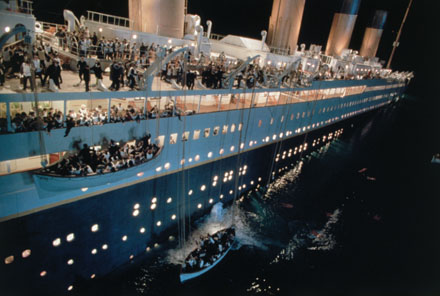
Many years back I went home to New England to see my family. My mom and I decided to go take in a movie, and the big one at the time (no pun intended) was James Cameron’s Titanic. I hadn’t seen it, she hadn’t seen it, what the heck.

Well, we all know the story. Big ship. Bigger iceberg. We were maybe two-thirds through the film and there’s that awful bit when Leonardo’s working-class buddy grabs a life preserver and hurls himself out into the icy water. He’s paddling away from the cries and howls and there’s this ear-splitting crack. The cables are snapping on the smokestacks. One of the huge towers creaks, tilts, and swings down over the water. Nameless friend of Leo (oh, come on–none of you remember his name, either) looks up as the smokestack blots out the sky and comes crashing down on top of him.

The audience wailed. People were already blubbering and misty eyed, but when Leo’s buddy was killed, well, that was the breaking point. Audience members were sobbing and crying out to the screen.

In the midst of all this, my mom turns to me and says, in a very loud, clear voice…

“What did they think was going to happen? It’s the Titanic, for Christ’s sake!”

So here’s problem one. As I’ve mentioned before, you can’t have drama or conflict in a story if the outcome is never in doubt. When we know what’s going to happen, it’s very, very easy for a story to veer off into boredom, melodrama, or both.

Not only that, but when we’ve already seen chapters thirty through fifty, we don’t want to go back to chapters one through ten. That’s moving backwards. We want to be going forward. You may notice that with much of the recent coverage of the crises in Japan, no one’s going back to do a retrospective on the Tokugawa shogunate of the 17th century. It’s an important part of Japanese history. It has a fair degree to do with why thing are the way they are in Japan today. But we really don’t need to know it to understand why a trio of nuclear reactors are being stabilized with hoses and buckets.

Now, in all fairness, and with all deference to my mother, Cameron’s Titanic is not about the ship. It’s a story of, if you’ll pardon the phrase, two star-crossed lovers which uses the disaster as a backdrop. The Titanic is no different than the feud between the Capulets and the Montagues or the impending gang war between the Sharks and the Jets. Can we even call that a war? The impending dance-off between the Sharks and the Jets. These are the plot elements that let the reader know from the start just how doomed this relationship probably is.

See, that’s the catch. We all know what happens to the Titanic. It’s a historic fact. We don’t know what happens to Leo and Kate, though. Will they survive? Will they die together? Apart? Will she live to be a middle-class ninety-year-old and toss a diamond worth a billion dollars into the depths of the Arctic Ocean as a meaningless gesture to her spring break fling who died three-quarters of a century ago?

Probably not that last one, because that would just be silly.

It’s the rest of those questions that make the story worth telling. I’ve talked about the problem with god-like forces in a story, and history is one of the most powerful ones out there (unless you happen to be a Time Lord…). If I know for a fact that character A survives until chapter thirty, it’s very difficult to get worried when she’s threatened in chapter three.

Obi-Wan Kenobi. Anakin Skywalker. Padme. R2-D2 and C-3P0. Yoda. Palpantine. Chewbacca. Bail Organa. The fate of every one of these characters was well-established twenty years ago in the original trilogy. Lucas asked us to make an emotional investment in characters we were already emotionally invested in. He asked us to worry about the future of characters whose future we already knew.

To be honest… that’s just plain boring.

This is the big challenge with any sort of “prequel” writing and it’s why a lot of these works tend to ring a bit hollow when all is said and done. To be honest, it’s one of the reasons I haven’t been all that interested in writing prequel stories for any of the characters in the Ex-Heroes universe. It’s also why The Nativity Story didn’t really work as a two hour feature film. We know what happens to these characters, so anything that happens in the story is automatically going to get robbed of some or all of its dramatic weight.

So, the burning question is… how do you make a prequel story work?

It’s not that hard, if you think about it. Don’t focus on events. We know the events. We know what’s going to happen. So that’s a dead end right there.

No, the secret to a good prequel is the characters. Don’t tell me about the guy I already know. Tell me about the other guy who was there. For example, we all know what happened to Abraham Lincoln that fateful night at Ford’s Theater. But what about the people sitting behind him? What about the security men on duty? Were they injured? Wracked with guilt afterwards? Secretly pleased? We don’t know the answers, so those are interesting questions.

You may have seen either the original version of The Clone Wars cartoon or the newer one that’s run for a couple seasons now. It’s very popular. It also focuses more on characters like Mace Windu, Cad Bane, and Kit Fisto–characters we don’t know that much about.

If only all the prequels had done the same.

Next time… well, I think we’ve finally come to the end.

Until then, go write.

March 11, 2011 / 4 Comments

Spilling Redux

Yep. It’s that time again.

I figured I was about do to talk abut spelling, as I due every sex months or so. It’s on of those things that needs to get hammered home again ant again, because no mater how many tines I say it, their is still this huge grope of people who incest that smelling doesn’t really effect how an editor vies you’re writing. Either that or they fill back on the hole “language evolves” defense.

Now, sum of you may bee giggling or filling a bite smug rite about now. After all, hear I am gong on about you’re bad spilling habits and halt of these wards are spelled wrong. Except, you seen, they aren’t. Not won singlet thin is spilled wrong inn these too paragraphs.

Which is the point I’m trying to make.

Y’see, Timmy, spellcheckers are idiots. Forget Watson or Deep Blue, your spellcheck program can be outwitted by my three-week old nephew banging on the keyboard with his little palms. Anyone depending on their spellchecker to save them from mistakes like the thirty-five in those first two paragraphs is doomed to a lot of rejection letters.

Yup, thirty-five. Count ‘em up. Keep counting until you find them all.

Of course, this doesn’t address the real problem. A lot of people don’t just have crappy spelling, they’ve got crappy vocabularies, too. When the idiot spellcheck suggests a word, these folks blindly accept it because they don’t really know which word they wanted in the first place. Which, if you think about it, is a bit like two homeless guys giving each other advice on the stock market.

So, let’s have a pop quiz. Pencils out, grab that spare Netflix envelope off the television, and let’s begin.

vicious or viscous — One of these words applies to wolverines.

cords or chords – One of these words deals with electronics.

sheer or shear — One of these words means see-through.

very or vary – One of these words means to change.

yore or your – One of these words applies to the past.

peak, peek, or pique — One of these words means the top.

discrete or discreet — One of these words applies to manners.

it’s or its – One (and only one) of these words is possessive.

corporeal or corpulent – One of these words means solid.

their, there, or they’re – One of these words is also a possessive.

trusty or trustee – One of these words is a person’s title.

canon or cannon — One of these is a big gun.

reign, rein, or rain – One of these words deals with emperors.

compliment or complement – One of these words means that things work well together.

So, got all your answers? Are you ready to grade this little test?

Well, here’s the catch. You’ll notice I never said what you were supposed to do. If you managed to pick the right words, that’s only part of the quiz.

You need to know all the words, what they mean, and how to use them correctly. Every single one of them. Knowing one out of three or even half of them doesn’t cut it because every one of those words is going to breeze past your spell check program without a problem– no matter which word you meant to write.

Bonus questions. Which one of the above words is a verb that means to cut? Which one’s an adjective that means thick? How about the musical noun? Which one of those words is best applied to a pile of books?

None of these should be hard questions. Seriously. These aren’t obscure words.

As I’ve mentioned before, there are lots of people who will try to convince everyone that the words you use and how you spell them does not matter in real writing. Spelling is all arbitrary, anyway, right? Such pedestrian things should be the very least of your worries.

There also a lot of people who fall back on the “language evolves,” excuse, as I brought up at the start. Modern English is not the same as Middle English or Old English. They also like to bring up Shakespeare as an example of someone who made up words that are now in common use today. Going with today’s theme of knowing what words mean, let me point out that ignorance is not a synonym for evolution.

Now, there are also lots and lots of people who have never been published, produced, or made the first cut in a writing contest. By an astonishing coincidence, a very large percentage of this group is made up of members of those first two groups.

What are the odds of that, I wonder…?

Y’see, Timmy, I know what all those words up there mean. Each and every one of them. So do most editors. Which means we will know when they’re used incorrectly, and each one’s another check mark in the “this writer doesn’t know what they’re doing” column.

How many checks do you think you’ll get before your manuscript ends up in that big pile on the left?

Stop asking your computer to write. Go buy a dictionary. Use it.

Next time, as I have a few times before, I’d like to look at one of the seminal influences of my childhood and where–in my opinion–it went horribly wrong. Even though I somehow managed to turn out okay.

Well, more or less.

Until then, go right.

Categories