
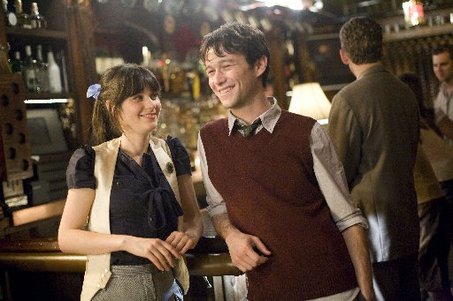
Harper Lee’s To Kill a Mockingbird is far more a slice-of-life story than it is a courtroom drama. The film (500) Days of Summer is closer to a character study than a romantic comedy. May 27, 2011 / 5 Comments
Artsy Character Stuff
Harper Lee’s To Kill a Mockingbird is far more a slice-of-life story than it is a courtroom drama. The film (500) Days of Summer is closer to a character study than a romantic comedy. May 20, 2011
A Challenge Has Been Issued
You would not believe what I had to go through to get this post up.
Anyway…
A simple element of storytelling is the obstacle. It’s what stands between the characters and whatever they want. An army of Nazis stand between Indiana Jones and the Lost Ark. The possibility of getting caught stands between Ferris Bueller and his perfect day off. The armored construct named the Destroyer stands between Thor and saving the world, but so does the inability to wield his mystic war-hammer, Mjolnir, because of his own doubts of his worthiness.
While opinions vary a bit more on this one, I think an obstacle is slightly different from a conflict. It’s just terminology, but exterior problems tend to be called obstacles, while interior ones are almost always labeled as conflicts. In the example I gave above Thor has to defend his friends from the Destroyer (obstacle), and he can’t wield Mjolnir because of his self-doubt (conflict). Make sense?
Now, while in strict literary terms obstacle is correct, I prefer to use the term challenge. I’ve found that thinking about “obstacles” tends to guide the mind solely onto physical impediments, like parts of an obstacle course. While this isn’t technically wrong, it does tend to result in a lot of the same things. This is when you get challenges that have that sort of “level boss” feel to them. Character A defeats obstacle B, then moves on to obstacle C, and finishes up with D.
Anyway, I did it a while back, but I thought it might be useful to scribble out some tips about challenges. And just so we can have cool, current pictures, I’m going to relate a lot of it to Thor. Some of them you might not have considered before, and a few of them… well, one or two it’s kind of sad that I feel it’s necessary to bring them up.
For example…
You have to have one.
Yeah, this sounds basic, I know, but it’s surprising how often I see stories where people either sit around doing nothing or just stroll through events with no effort. I ranted on about this sort of thing just a few weeks ago. Anything the characters need just appears. Anyone they need is willing to help with or without any motivation to do so. Any lucky break that has to happen does at the precise opportune moment. I know it sounds silly to most of you, but it’s honestly stunning how often this happens in amateur books and screenplays. Heck, it’s bothersome how often it happens in professional writing.
There needs to be something between your characters and their goals. If there isn’t, they would’ve accomplished these goals already. If I want a Diet Pepsi, I go get one from the fridge– that’s it. Hardly material for a bestseller, no matter how much you dress it up. On the other hand, if I want to drink from the Fountain of Youth, odds are there are some immortal pirates and conquistadors in the way, maybe a few alligators, quicksand, and the random swamp monster. That’s a story.
Your characters need a reason to confront it.
If your characters are going to take on a challenge, they need a reason to do it. A real reason. Indy isn’t chasing those Nazis halfway across two continents for an empty crate—he’s doing it for an artifact which represents the sum total of his entire life’s work. Thor isn’t squaring off against the Destroyer because he can’t think of any other way to spend the afternoon—the lives of his friends and innocent civilians are at risk.
Make sure this reason is really there. It might be obvious in your head why the characters are going to undertake a challenge, but is it that clear on paper? This is especially true for more internal things like Thor dealing with his pride issues, where the audience needs to understand why not being able to lift Mjolnir is such a big deal.
You need a reason for it to exist.
A combination of the first two points. Nothing’s worse than a challenge that only exists to be a challenge. It has no reason for existing in the world of the story, no past, no future, no motivation. It’s only there to serve as an obstacle for the protagonist to overcome. You might remember in Galaxy Quest when Sigourney Weaver loudly points out that the mashing hallway serves no purpose whatsoever. We can probably all think of a book or movie where, for no reason at all, an obstacle just popped out of nowhere. That kind of stuff just weakens any story.
Challenges have a purpose. They’re characters in their own right, or maybe obstacles other characters have set in your protagonist’s way. There’s a reason the Destroyer exists (it protects Odin’s vault), and there’s a reason it’s going after Thor (Loki ordered it to kill him). It didn’t just fall out of the sky and start smashing stuff for no reason. Think about why a given challenge is in your story, and if there isn’t a real reason, stop for a couple minutes and re-think it.
I’ll add one other note here. It’s generally better if the audience (reader or viewer) has at least some idea why said challenge exists. They don’t need to know immediately, but you also shouldn’t save it for the last five pages and say “Oh, the ninjas that have been hunting us for the past week? They were sent by my business rival in Hokkaido…”
It has to be daunting.
It’s bad enough the Destroyer was built to be the ultimate killing machine, but Thor has to face it with no powers whatsoever. No strength, no armor, no thunder, nothing. Atticus Finch stakes his career, his personal morals, and possibly his life on his defense of Tom Robinson. Jonathan Harker, Dr. Van Helsing, and their companions are the only who ones who know a supernatural monster has arrived in England—one that could kill tens of thousands if not stopped.
Characters should never want to deal with a challenge, because let’s be honest– we’d all love it if more things were just handed to us. Again, Diet Pepsi vs the Fountain of Youth. A challenge needs to be something that gives the character (and the audience) pause, or else it isn’t really a challenge. Even John Carter, gentleman of Virginia, Warlord of Mars, and greatest swordsman of two worlds, would occasionally look at the odds he was facing and say “Oh…crap.”
Well, Burroughs was always a bit more eloquent than that, but you get the point.
It can’t be impossible.
There’s nothing worse than being on the wrong side of a sure thing. Nobody reading this wants to get in a fist fight with Dwayne “The Rock” Johnson because we all know it’d be no contest. None of us want to be given the responsibility of stopping a runaway asteroid or even just a runaway bus, because I’m willing to bet for all of us here (myself included) those would be things we just couldn’t deal with.
If you’ve ever watched a boxing match, or any sporting event, you’ve probably noticed they’re evenly matched. NFL teams don’t face off against pee-wee football teams. The Yankees and the Red Sox don’t do practice games against little league. The most boring stories tend to be the ones where the protagonists have no chance whatsoever of meeting the challenge. If you’ve ever watched a horror movie where the killer is merciless, unstoppable, and inescapable… well, that gets pretty dull after the second or third kill, doesn’t it? One of the reasons Jason Voorhees was always scary in the Friday the 13th films (well, the originals, anyway) is that he never ran. He just sort of… marched? It always seemed like somebody had a chance of getting away from Jason if they could just go a little faster… and not trip on a root or a broken heel or something.
The other risk to be careful of here is if the challenge is completely impossible and your protagonist pulls it off anyway, it can look unbelievable and knock your audience out of the story.
Another thing to be wary of is the challenge that seems impossible to the character, but has a painfully obvious solution to the reader. This makes the characters unlikeable, by nature of stupidity, and that’s not going to win anybody points.
It should be unexpected.
This isn’t an absolute rule, but it’s something I still lean heavily toward. It’s the next logical step once you admit there has to be a challenge.
Every heist movie involves an enormous challenge—usually getting past near-foolproof security to break into a vault or museum. There are many chapters or scenes of preparation. Then, almost without exception, in the middle of pulling the actual job, something always goes wrong. There’s a variable that wasn’t accounted for, something the heroes and the audience are not expecting. A new set of guards, new security equipment, or maybe just a drunken woman at the bar who distracts people and throws off the timetable. There have even been a few clever stories where it’s not the heist that has the unexpected twist but the payoff. And this is where the story gets exciting. If my heroes are so trained and ready for anything that the job goes off without a single hitch, there really wasn’t a challenge, was there?
A small bonus of the unexpected challenge is that it often gives your characters a chance to look better. When they beat the unexpected challenge through sheer skill or cleverness, it makes them all the more likable.
You need to resolve it.
Once the writer has set up a challenge, the readers need to see it resolved somehow. We can’t set the Destroyer loose on the world and then just forget about it. To Kill A Mockingbird doesn’t dangle the threat of a mob in front of us for the whole book and then have nothing happen. I can’t have the hero pining over their lost love for the first third of my story and then never, ever address those feelings again. Believe me, your readers will remember these things. Once we, as writers, present a challenge to the audience it can’t be forgotten or ignored. As Chekhov said, if we see a phaser on the bridge in act one, we need to see it fire in act three.
So, if you’re up to it, make sure the challenges in your writing really are challenging, for the characters and for your audience.
Next week I’m going to accept a challenge myself, and talk about something I don’t like.
Until then, go write.
May 13, 2011 / 2 Comments
Sounds Good
I refuse to take the blame for being late. Blogger was down. Not my fault.
And now back to our regularly scheduled rants and hair pulling…
As has been said many times before, by other people than just me, the key to great characters is dialogue. The way they communicate often tells us just as much about someone as the actual information they’re communicating. If you can’t pull off good dialogue, your career as a writer is going to be an uphill battle the whole way.
The most common way people mess up dialogue is by having, well, god-awful dialogue. Sounds silly, but there it is. Some dialogue just sucks. It’s wooden, on the nose, devoid of any emotion. All you have to do is read it out loud and you can tell it rings false. Making a cheeseburger with rotten meat and moldy cheese is bad—no further explanation is needed. If you can’t figure that on your own, there’s not much anyone can do for you.
The second most common way, believe it or not, is the complete flipside. It’s when people write dialogue that’s too real. Which sounds bizarre, I know, but let me explain…
If you listen to people a lot—people in the real world, not on television—you’ll see that they rarely use complete sentences. Oh, there are a few remarkable statesmen in the world (not all of them politicians) who can speak on any topic and make it sound like they’ve rehearsed their answers a hundred times. For the most part, though, people speak in bits and fragments. We split infinitives, backform verbs, and don’t always match those verbs to the correct number. We pause in mid-thought and try to pick up the threads a moment later. We beat around the bush and sometimes we stall so we can get the rest of our thoughts in order.
You can see this yourself by listening to a recorded conversation. Try it. Ask a friend or two if you can tape a conversation and then talk about anything. The game, politics, a movie you saw, that new pizza place down the street, the new girl at the checkout counter, whatever. They might be a bit stilted at first while they think about being recorded, but eventually you’ll both settle into normal speech patterns.
Now try to transcribe that recording—the whole thing. Write down every pause or false start in the conversation. You’ll probably be surprised how many times you stop in the middle of a sentence and then start over. Or how many times your friend makes a funny noise to fill space while he or she tries to assemble words in the right order.
Get more than two people and you’ll become aware how many random comments people make. And how much space those comments start to eat up, especially when they need to be attributed to someone.
Realistic sounding dialogue is not the same thing as real dialogue. As the saying goes, art imitates life. If art and life are the same thing, though, then you’ve just got life, not art (‘cause we’re not getting rid of life).
I’ve seen a few amateur screenplays that get this wrong in a key way. You know when you walk into a room and half a dozen people say “Hi” and there’s a little burst of small talk from all corners before things settle down again? Some people write that into scripts. So you get six or seven people saying “Hello” and the new arrival responds to all their greetings. Three or four of them ask one like questions like “What’s up?” or “How’ve you been?” or “How’s Wakko?” and the new arrival answers each with two or three words.
Yes, this is very, very realistic. It also means the writer has just taken two and a half pages (when formatted correctly) for what will possibly be thirty seconds of screen time. Unless it’s completely, 100% integral to the plot and half your story will just collapse without it, this kind of thing stands out like a flare for readers as “rookie mistake.” It’s also something that can be written off with “Wakko enters the party, greets a few people, and makes his way over to Phoebe.”
Now, there’s a second part to dialogue that’s too real. If you’ve ever worked in any sort of special field, you’ve probably noticed there’s a certain jargon that develops. Each grocery store, department store, or restaurant has their own behind-the-scenes, shorthand terms for things. If you’ve ever worked in a very intensive field that swallows up a lot of your life—say medicine, the military, or even the film industry—that jargon almost becomes another language. There’s a ton of specialized terms and phrases and abbreviations that get used by people in these fields.
Now, again, here’s the catch. People outside of these fields don’t talk like this and don’t know what these terms mean. Some writers, in the attempt to make their dialogue as realistic as possible, actually make it completely impenetrable. It’s so authentic no one can understand it except other professionals from that field.
The trick for writers is to make this dialogue sound authentic while still being accessible. Think of it like this—you’d never write a character talking with a non stop accent or thick dialect because it becomes difficult to read. You’d pick out a few key phrases and terms and just use those. Things like dropping in “all y’all” instead of “all of you” or saying “pop” instead of “soda.” These give a character a certain flavor without forcing the reader to sound out everything they say.
A great example of this would be television shows like House or NCIS or (dare I say it) JAG. These are shows about people in exceptionally specialized fields, each of which has its own terminology and jargon.
In real life, if a handful of lawyers were discussing a case or four doctors were sitting around discussing possible diagnoses of a patient, odds are most of us wouldn’t understand a single sentence (and none of the doctors would look like Olivia Wilde). So the writers of these shows only pepper the dialogue with such terms and flesh out most of it with straightforward, easily-understandable terms. Think about it—when they’re in the middle of a diagnosis, most of their dialogue is explaining their ideas so they’d make sense to a layman.
“Tansey syndrome explains the aversion to light and pale skin. But if you write off the pale skin as a side effect of light sensitivity, not an actual symptom, chloroblastosis of the heart is a better match. It explains the aversion to light, elongated teeth, and the craving for blood… So start treatment for chloroblastosis.”
We don’t need to know what Tansey syndrome or chloroblastosis is because it’s getting explained to us. It’s not how doctors would actually talk, yes, but it still sounds good to the layman and it’s understandable to the layman. And it’s got enough facts right that hopefully doctors won’t be too annoyed or amused. Ignoring the fact that I just made up two medical conditions.
When I was writing Ex-Patriots I knew there was going to be a strong military presence in the book. While I don’t have any experience in that world myself, I was extremely fortunate to have a web of people I could call on. My best friend was in the Air Force. My dad was in the Navy. My step-sister was a Master Sergeant in the Army. I also know a couple other authors with a wide range of military experience.
But I also knew I was writing for a much broader audience than just the military. So I needed to have soldiers speak more like civilians at some points. If I didn’t, I’d run the risk of either alienating the readers or having to explain large swaths of dialogue. Neither prospect was all that exciting.
So don’t write what you know. Write like you know what you’re talking about.
Next time, writer challenge!
Until then, go write.
May 10, 2011 / 2 Comments
More Shameless Self-Promotion…
On the off chance you didn’t know, I write books for a living. People actually buy them. For money.
A while back my publisher cut a deal with Audible.com and now they’re having a wonderful little cross-promotion called Zombiefest. All this summer there are going to be zombie audiobooks up for great prices from Audible.com. I’ve got one in the first wave, just released today (Ex-Heroes) and it seems I’m also first out in the July wave, just after Fourth of July, with Ex-Patriots. Plus the books in the July wave come with a little bonus material, also by me, called The Junkie Quatrain.
So check it out.
Thursday I still plan on rambling on about how you can sound professional. Is anyone still reading? Haven’t been any comments in a month or two, now…