
October 18, 2018 / 3 Comments

Chalk Outlines

Oh, hey, it’s Thursday again.

A few weeks back I asked for possible topic ideas and somebody mentioned outlines.  It’s a good topic, and a good time for it since I’m early into a new book.

Fair warning up front.  This whole post is very much going to follow the golden rule.  Outlining is an intensely personal process, and it changes from author to author and even from project to project.  Figuring out what works best for me (or you) might take four or five or twenty attempts.

Hey, nobody said this was going to be quick and easy.

Nobody who knew what they were talking about, anyway…
Outlines are tricky things.  Depending on who you ask, they’re the most important part of the process or a complete waste of time.  They just need to be a few rough lines of notes or pages and pages of meticulously planned out beats.  They can make things incredibly restrictive or let me spit out pages without a moment of hesitation. 

As I mentioned above, I think outlines are incredibly personal.  I’ve talked once or thrice before about how everyone has their own method when it comes to storytelling.  Maybe outlines are part of that method.  Maybe they’re not.

A good analogy—one that’s going to come up a lot here—is travel plans.  There are lots of different ways to travel.  Some of them might make perfect sense to you.  Some of them might be terrifying.  Again, it’s all about what works for you.

So let me blab about how outlines fit into my method a bit.

Or how they’ve fit over time.

First, there’s a pair of terms you may have heard before—plotters and pantsers. It’s (supposedly) the two big groups writers can get divided into.  Plotters are the folks who plan everything out in advance.  Pantsers make it up as they go along—by the seat of their pants.  Get it?  Hahaa, funny stuff. 

This is pretty simplistic, though, and I’ve had a couple discussions with other writers about the problems with such basic classifications.

I started out as a pantser.  I’d sit down at the keyboard and just type and type and type.  New characters, plot points, subplots… the book just went where it went, y’know.  This was how a lizard man from the center of the Earth ended up finding a crystal cave and wielding Excalibur.  Yes, that Excalibur.

Granted, I hadn’t even hit puberty yet.  But even after I did, most of my attempts at writing were usually just me coming up with one clever idea, starting at a point that I knew would take me straight to that idea, and filling in the rest as I went along.

And there’s nothing really wrong with that method.  It’s kinda like grabbing that special someone, throwing some clothes in a bag, and just going.  Pick a direction and drive.  Choose a flight at the airport.  Just go and see where you end up.

I still remember when I made the next big leap in my sophomore year of college.  A lunch conversation with a woman I was dating sparked an idea for a story about an immortal wandering the world.  Which sparked the story of another immortal.  Which implied a third.  And suddenly I realized this would be the beginning of a really cool book.

A week or so later, in the midst of writing all this down, it struck me that I had no idea what this book would actually be about.  I knew the characters, had cool origin stories for them, but past that… 

So, for the first time, I sat down and figured out—in advance—more or less how this story was going to end.  I came up with a pretty solid idea what actions the heroes and villains would be taking on the final page.  Who was going to win.  Who was going to lose.  Even a clever denouement.  And I knew it was a denouement because I’d just learned that term a few weeks earlier.
This is the slightly more planned trip, if we want to keep using that analogy.  Also in college, one of my best friends and I talked about driving cross-country after graduation.  We knew we wanted to end in California, but past that…  The rough plan was just grab clothes, maybe cameras, and go west.  Probably in her car, which was much more suited to a roadtrip than mine.  We knew eventually we’d hit California and the Pacific and who knows what along the way.

We never ended up going.

Anyway… time passes.

My next big outlining leap was kind of a bookkeeping thing.  I tended to scribble out five or six key plot points, but kept most of the story in my head.  Even with big, novel-sized projects.  When I decided I really wanted to start taking this seriously, one thing I started doing was writing everything down.  Every plot point, every idea, every snippet of action or page of dialogue.  When I finally sat down to write, I’d already have five or six pages of jumbled… stuff.  I might spend an afternoon putting it into a rough order and then—done.  Outline.

If we want to stick with our road trip analogy, this is when we know we’re taking the southern route across the USon our way to Los Angeles.  We’re also going to be stopping in Gracelandand Roswell.  A pretty good idea of direction with a few markers along the way.

Again, perfectly acceptable method.   Fine way to do things.  The first four books I sold (sold for actual money) were all written that way.  My book -14- had a little over eight pages of notes, and that included two and a half pages of character sketches. 

It was right around this time that I ended up with Crown Publishing (a division of Random House) and became a writer with a contract.  I mean, I’d had contracts before, but this was the first time the contract came first.  Everything I’d done up until this point had essentially been on spec, me writing the book at whatever pace I wanted and then hammering out a deal afterwards. 
What I was really dealing with now was a schedule.  A timetable of when things had to be done.  This wasn’t just about me anymore.  People had given me large advances based on the idea I could stick to these schedules.

My first contract with Crown was rough.  Exciting, but rough.  I ignored a lot because holy crap I was a Random House author now!!! 

My second contract…

I’ve got to be honest, the second one was brutal.  I’m still kinda aching from it.  Aching in that “Maybe I shouldn’t’ve asked Conor McGregor if he wanted to step outside” way.  It was about two years of near-constant stress trying to get through three books, start to finish.

And to be very clear—it wasn’t about them.  Despite what you may hear on some sites, the folks at Crown weren’t evil taskmasters or uncaring overlords or anything like that.  Hell, my editor gave me extra time whenever I even hinted at needing it.  he wanted the best book they could get.  Of course, extra time on book one meant I was getting into book two later, so I’d have less time for that…  But still, that was all me.  He was fantastic and accommodating pretty much every time an issue came up.  Everyone there was.  So don’t even think of using this as evidence of how “mean and demanding” traditional publishers can be.  It was absolutely, 100% nothing of the sort.

No, all that stress was on me.  My ambling, feeling-things-out-as-I-go method of writing was fine when I could go at my own pace.  But now I was on a schedule.  Those spaces in the outline where I still needed to figure things out had to be a lot smaller, because I just didn’t have time for them.

So—with some gentle prodding from my agent—I started doing larger outlines.  Now I actually figured out the majority of the story points and plot beats and character arcs in advance.  All the twists.  I had to have an ending—an entire ending—mapped out.

If we want to fall back on travel plans, this is when you’re going past “plans” and into more of an itinerary.  Things are mapped out hour-to-hour now.  Most notably, when you’re done traveling.  I just had that trip to Texas last weekend and honestly… having a full itinerary set up for me was kind of comforting.  Of course, my mom tried doing a family trip like this for us when I was twelve and it was… well, a bit less than fun.
My first couple outlines like this were just shy of twenty pages.  And really, that’s nothing.  The book I’m working on right now has a forty-two page outline.  I’ve got the next book about 2/3 plotted and it’s already close to thirty.

Want to hear impressive?  Back when I was doing a lot of screenwriting interviews, I talked with  Tony Gilroy about his script for Duplicity.  He had, by his guess, a sixty page outline.  For what would eventually be a120-130 page screenplay.  He had the whole thing nailed down.

And to be clear, this took time.  Lots of time.  It flexes different mental muscles to be examining the story in a much more clinical way.  And twice I had to junk half my work and start again.  A week or so of work—gone.

I spent about three months last year working on a handful of outlines (one of which I may never do anything with, after all that hammering and rewriting)

To be honest… I’m still not entirely sure I could say outlining saves time.  It may cut four or five weeks off the writing time, but if I spent four or five weeks working on the outline… well, it all just balances out, doesn’t it?

I guess we’ll have to revisit this six or seven months from now.

Again, please don’t take this as me saying you have to use this last method if you want to be a successful writer.  There are no such guarantees and  it’s all going to vary from person to person.  Like I just said, I’m still not 100% sure it’s going to help mebe  successful.  You may try a few of these versions before you figure out which one works for you.  Or you may find a different one altogether.

So think about the path you want to take.

Next time… I’d like to talk about why this is all happening.  To be more exact, why it’s all happening right now.

Until then, go write.

August 30, 2018 / 4 Comments

If I’m Being Honest With Myself…

            Okay, look… there’s a good chance this post will piss you off.
            Two things I ask you to keep in mind, going in.
            First is that this comes from a place of kindness.  If you’re reading this, I want you to succeed.  All of you.  Well, okay, not him, but the rest of you, absolutely.  So I’m saying these things because… well, they need to be said.  And you need to hear them.
            Some of you really need to hear them.
            Second is that everything I’m going to be talking about is something I’ve personally experienced.  Not that I’ve seen another writer doing it—I’ve done it.  I’ve believed it.  I’ve been the person needing that smack in the face.
            And I learned from it.  And got better because of it.
            Writing’s tough.  It’s hard work.  I know this, because I’ve been doing it for a living for over a decade now.  When someone tells me how easy and wonderful and fun writing is, I’m often tempted to point out…
            Well, look.  There was a point when I thought writing was easy and fun.  It was back when I wasn’t taking it seriously.
            My writing ability started making huge leaps when I was finally able to admit a few things to myself.  I think that’s true of most people in most fields—if we can’t be honest about where we are, it’s hard to improve.
            That being said…

My first attempts at writing will suck—This sounds harsh, yeah, but… well…  Too often when we’re starting out, we just can’t get past the idea that something we wrote isn’t good.  I know I couldn’t.  My work was typed.  It was a full page long!  My mom liked it!  Of course it deserved to sell.  It deserved awards!  International awards!

            Seriously, there was soooooo much writing before my “first novel.”  There was Lizard Men from the Center of the Earth (two different versions).  A trope-filled sci-fi novel.  Some Boba Fett and Doctor Who fan fic.  A fantasy novel  fuelled by a sudden influx of hormones during my teen years (enough said about that).  The Werewolf Detective of Newbury Street, The Trinity, The Suffering Map, about half of a novel called Mouth.

            And then…Ex-Heroes. 
            It’s just against human nature to spend hours on something and then tell yourself you just wasted a bunch of time.  Why would I write something I couldn’t sell?  Obviously I wouldn’t, so my latest project must deserve a six-figure advance.
            The problem here is the learning curve.  None of us like to be the inexperienced rookie, but the fact is it’s where everyone starts.  Surgeons, chefs, pilots, astronomers, mechanics… and writers.  Oh, there are a few gifted amateurs out there, yeah—very, very few—but the vast majority of us have to work at something to get good at it.  And we can’t improve until we accept that we need improvement.
My first draft is going to suck—There was a point where I’d fret over my first draft.  I’d spend hours laboring over individual words, each sentence, every paragraph.  I’d get halfway down the page and then go back to try to fix things.  It meant my productivity was slowed to a crawl because I kept worrying about what had happened in my story instead of what was going to happen.
            The freeing moment was when I realized my first draft was always going to suck.  Always.  And that’s okay.  Everyone’s first draft sucks.  Everybody has to go back and rework stuff.  It’s the nature of the beast. 
            With those expectations gone, it became much easier for me to finish a first draft, which is essential if I ever wanted to get to a second draft.  And a third draft.  And maybe even a sale.
            No, needing another draft doesn’t make me a lesser writer in any way.  Every single professional writer I know (and I know a lot of them at this point) does a second draft.  And usually a third and fourth.
My writing needs editing.  Lots of editing—As I mentioned, I’ve been doing this for a while.  Surely by now I’ve hit the point where my stuff rolls onto the page (or screen) pretty much ready to go, yes?  I mean, at this point I must qualify as a good writer and I don’t need to obsess so much over those beginner-things, right?

            Alas, no.  Like I just said, my first draft is going to need work.  We all make the easy first choice now and then.  Things slip past us.  We misjudge how some things are going to be read. I’m fortunate to have a circle of friends and a really good editor at my publisher who all call me out when I make these mistakes or just take the easy route when I’m capable of doing something better.

            As I mentioned above, part of this is the ability to accept these notes and criticisms.  I’m not saying they’re all going to be right (and I’ve been given a few really idiotic notes over the years), but if my default position is that any criticism is wrong then my work is never going to improve past the first draft. 
            Which, as I mentioned above, sucks.
My writing needs cuts—Sticking to the theme, if I believe my writing is perfect, it stands to reason all of it is perfect.  It’s not 90% perfect with those two odd blocks that should be cut.  When I first started to edit, one of my big problems was that everythingneeded to be there.  It was all part of the story.  Each subplot, every action detail and character moment, all of the clever references and in-jokes.
            The Suffering Map was where I first started to realize things needed to be cut.  I’d overwritten—which is fine in a first draft as long as I can admit it in later drafts.  I had too many characters, too much detail, subplots that had grown too big, character arcs that became too complex.  It took a while, but I made huge cuts to the book.  It had to be done.  Heck, I just cut a whole subplot from the book I’m editing right now.  About 2500 words gone, snip-snip, in about five minutes.
            And the book it better for it.
My writing is going to be rejected –Know what I’ve got that most of you reading this will never have?  Rejection letters.  Paper letters that were mailed to me by editors.  I’ve got dozens of them.  Heck, I’ve probably got a dozen from Marvel Comics alone.  And since then I’ve got them from magazines, big publishers, journals, magazines, ezines…
            But when that first rejection from Marvel came… I was crushed.  Devastated.  How could they not like my story?  It was a full page!  I included a colored pencil rendering of what the cover should look like.  Did I mention it was typed?!
            It took me weeks—whole weeks, plural—to work up my courage to try again, and then they shot that one down, too.
            Granted, I was eleven, and those stories were awful.  I mean… really awful.
            Rejection is part of the process.  I still get rejections today.  I expect I’ll be getting then for the foreseeable future.
            Which is a good time to mention…
Rejection does not automatically mean my writing is bad—Getting that email is tough, like a punch to the gut.  It’s easy to let it get under the skin and fester.  Self-doubt feeds on rejections, so it’s important to think of it as “still looking for the right home.”
            Like I said, I’m still getting rejections today, even with the fairly solid list of credits and accolades after my name.  Editors and publishers are people too, and nothing is going to appeal to everyone.  Getting rejected became a lot easier for me when I realized it didn’t show up on my permanent record and it wasn’t a personal attack  It was just a person who didn’t connect with that particular story for some reason.
            Now, there’s a flipside worth mentioning here…
Rejection also doesn’t automatically mean my writing is good—There’s a lot of memes and recurring stories and a few general mindsets that push the idea that if my work gets rejected by an agent or editor it mustbe good, because all those people are idiots.  And it can be a comforting thought.
            It’s also kinda close to conspiracy-theory reasoning, if you think about it.
            Going right back to the beginning of this little rant, there’s a decent chance my work just isn’t good.  No big deal.  Like I said, I had dozens and dozens of rejections before I started to get some sales.
            But if I refuse to back away from the idea that it might be me—if I take dozens of rejections as proof the system is stupid rather than admit the possibility my manuscript wasn’t ready to go out—then I’m never going to improve.
           
            If I can admit these things to myself, it can only make me a better, stronger writer.  It’s not a flaw or a weakness.  In fact, if I look at the above statements and immediately think “Well, yeah, but none of that applies to me…” it’s probably a good sign I’m in denial about some things.
            And that’s not going to help me get anywhere.
            Speaking of getting anywhere, if you’re in the Atlantaarea I’m at Dragon Con this weekend.  Come find me and we can talk about books and writing and is Clark Gregg coming back to Agents of SHIELD or what?
            Next time, I’d like to put a few things in context.
            Until then, go write.
July 12, 2018 / 2 Comments

I Don’t See Color

            I know, I know.  Asking-for-trouble title on this one.  Please just stick with me, though, okay?  There’s a good reason for it.
            Which I shall explain with this shocking revelation and a quick story.
            When I was in seventh grade, I found out I was color blind.  This may seem like a weird thing for someone to “discover,” but it makes sense if you think about it.  I’m daltonic (or deuteranomalous if you want to get super-specific), which means I can see most colors, but I have trouble with reds and greens.  I just kind of learned by filling in the blanks. 
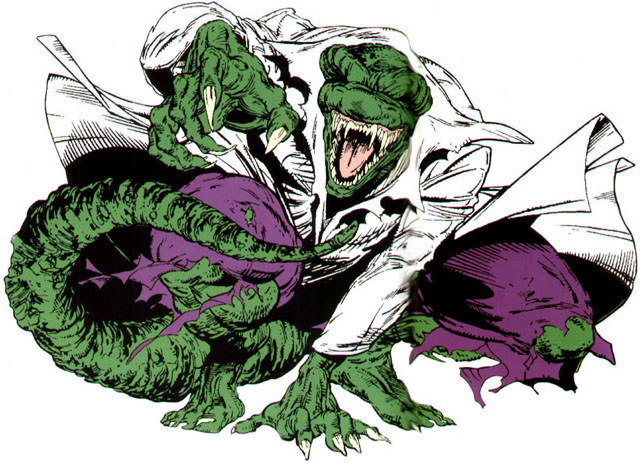
            For example, leaves, Sleestaks, and the Hulk were green.  Grass is the same color as leaves, therefore grass is also green. The Lizard is the same color as the Hulk, therefore the Lizard is also green.  I just matched things up with what I learned from books and comics and Sesame Street.
            In other words… I learned just like everyone else did.
          Of course, it never occurred to me that what I was seeing might not be what everyone else was seeing. Why would it?  My vision was perfectly normal.  Nothing made this more clear than several determined childhood attempts to manifest either X-ray vision or optic blasts.
            (and maybe teen attempts)
            (…okay, last week)
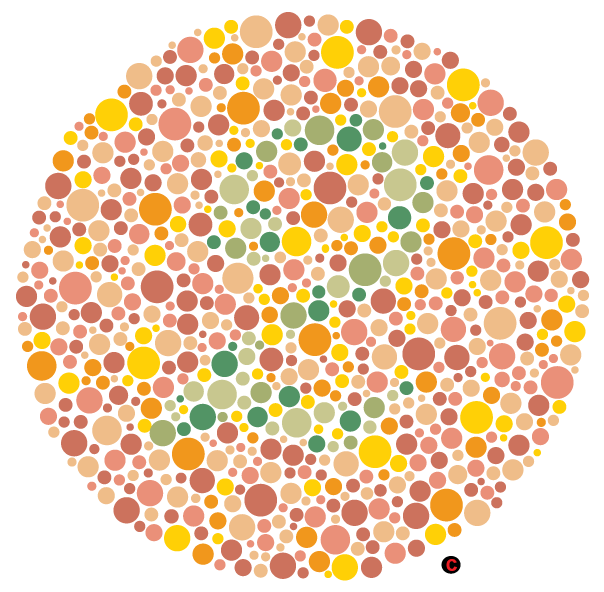
            Then one day I got to Science class and the teacher had a slide show set up.  It was a bunch of those pictures-hidden-in-colored-dots things (an Ishihara test, if you were so interested).  Like that one right down there.  And much to my surprise… I couldn’t see anything in them.  Almost two-thirds of them looked blank.  Just like that one down there.  I can’t see anything in it. No pictures or patterns or anything.  If you can, feel free to say something in the comments.
            Anyway, I had a low-level, seventh grade freak-out about all the important stuff—Will I still be able to get a drivers license?  Will I have to get glasses?  What girl will ever want to kiss me knowing I’m color blind?!
          Once that was done, I spent the next day or two re-examining my whole world.  What did Sleestaks really look like?  That “grass is always greener…” thing had always seemed stupid to me, but did it make sense to everyone else?
           And that’s when it suddenly hit me.  How did everyone else see the world?  What was I missing out on?  I mean red, white, and blue Captain America looks really good to me, but how much of that was being told for most of my life that red, white, and blue were complementary?  How did everyone else see those red stripes?  I couldn’t imagine a “new” color that could fill that slot.  Would most people be horrified at what I saw?
            I spent weeks pondering this.  What were other people seeing?  How were they experiencing the world?  If red was the color of anger… was their anger different than mine?  Their envy?  What would alternate-green envy be like?  I was honestly second-guessing everything (which, granted is what most of seventh grade is, but this was on top of the usual stuff).
            Anyway…
            Once or thrice here I’ve talked about empathy.  Really simply, it’s the ability to understand what other people are going through.  If your friend has a hangover, goes through a bad breakup, or saves a bundle on car insurance with Geico, these are all experiences we can relate to, and we can apply how we felt to guess how they’re feeling.
            But really, empathy goes beyond that.  I still have both of my parents, so I didn’t know what it was like when one of my friends lost his.  But I could extrapolate from how I feel about my parents and from huge losses I have suffered.  Empathy’s being able to relate to people even when you haven’t directly experienced what they have.
            I’ve never had that ice-water in your spine moment what I realized I’m sitting in an office with a serial killer. I’m guessing most of you reading this haven’t, either. But our job is, quite literally, to convince people we have.
            Y’see, Timmy, I don’t think it’s exaggerating to say I can’t be a good writer if I don’t have empathy. If I can’t see the world through the eyes of different people—not how I think they see the world, mind you, but how they see it—I can’t have good characters.  And without good characters…
            Well, you know.
            Next week is… oh, holy crap, next week is San Diego ComicCon!  And I’m going to be there next Thursday, hosting a Writers Coffeehouse with Jonathan Maberry (he of Glimpse and V-Warsand the Joe Ledger books).  Plus I’ve got a couple of signings scattered through the day.  I’ll put up a schedule very soon.
            And next week, for the rest of you…
            Well, I’ll come up with something.
            Until then, go write.
July 14, 2017 / 1 Comment

SDCC Schedule

            So, between the Writers Coffeehouse, a doctor’s appointment, the event at Mysterious Galaxy last night with Daniel Price… this week’s been kind of a blur.  I don’t have an actual post for you.  There is nothing to learn about writing this week.
            However…
            I did want to mention my San Diego Comic Con schedule.  This kinda snuck up on me in a couple ways.  I wasn’t sure I was going to be going, and my big plans for the weekend really involved putting together my Lizardman/Seraphon army for Age of Sigmar.  Geek thing, don’t worry if that last sentence made no sense to you.
            Anyway, turns out the folks at Random House had some clever ideas for early Paradox Bound stuff and they asked if I wanted to be part of them, sooooo… the Lizardmen will have to wait.
            Here’s what I’ve got for you…
Thurs 7/20, 1:00-2:00 – I’m doing a signing at the Crown Booth (1515).  It’s going to be cool. If you’re a fan you really don’t want to miss this, okay?  Seriously.  Please be there and hop in line.  It’ll be worth it, honest.
            And that’s all we’re saying about that…

Friday 7/21, 3:00-4:00 – Some random giveaways at the Crown Booth (1515). Odds of being given something increase if you tell them– “The road beckons.”  I’m not officially there, but I’ll probably be informally hanging out/lurking a bit if you had something you wanted me to scribble on. 

            Or if the booth folks handed you something you wanted scribbled in.
Saturday 7/22,  1:00-2:00– There’s a cross-genre panel in room 28DE. I’m up there on stage, but so are a lot of better, classier authors like Sarah Kuhn, Charlie Jane Anders, Vic James, Daryl Gregory, and Pierce Brown.  It’ll definitely be worth it to see all of them.  And one of us may something wise and clever about genre writing.  Or at least funny.

Saturday 7/22, 2:15-3:15—All the folks from that panel are going to be under the sail for a signing (area AA09).  And Mysterious Galaxy will be there with piles of books from all of us, so it’s a great chance to get something scribbled in without having to lug it around for half the day (and to fill in those holes in your collection).

            I don’t have anything official scheduled for Sunday, so—to be horribly honest—I’m not sure I’ll be there or not.  I may try to sneak off with that life sized Spider-Man LEGO sculpture.  We’ll see how that goes…

            Hope to see some of you there.

Categories